Introduction
Revelation is a confusing book to most people despite the many commentaries written. The reason most commentaries fail to enlighten the book’s contents is because they violate one or more of the three basic principles of sound biblical interpretation. These are the following: 1) acceptance of the Scriptures as God-breathed (θεόπνευστος), 2) correct placement of the text within the framework of God’s progressive revelation, and 3) sound and consistent hermeneutic or interpretative method.
The first word of the book is “revelation” (ἀποκάλυψις)–hence its title. The word means to “unveil,” or “reveal.” The first phrase of the book is (Ἀποκάλυψις Ἰησοῦ Χριστοῦ) “Revelation of Jesus Christ.” The “revelation of Jesus Christ” should be interpreted as both a subjective and an objective genitive. The book reveals Jesus Christ, the God of the Bible, in His role during the Tribulation and as King of Kings (subjective genitive) and is the revelation from Jesus about the events that will transpire during the Tribulation and afterwards (objective genitive).
God wishes us to understand His Word (cf. Revelation 1.3). The goal of this study is to reveal to whom the book was written and the purpose of the book.
Summary
| Title | The Revelation of Jesus Christ (Revelation 1.1). | |
| Meaning | “Revelation” (ἀποκάλυψις) means “disclose,” “unveil,” “reveal.” Subjective and objective genitive: Christ is revealed and He reveals things to come. | |
| Message | Overcoming (νικάω) in the Day of the Lord (Revelation 2.7, 11, 17, 26, 3.5, 12, 21, 21.7) | |
| Author | The Apostle John (Revelation 1.1, 4, 9) | |
| Location | Written from the isle of Patmos (Revelation 1.9) | |
| Occasion | The Day of the Lord: ἐγενόμην ἐν πνεύματι ἐν τῇ κυριακῇ ἡμέρᾳ (Revelation 1.10) | |
| Audience | Seven Jewish assemblies in Asia Minor (Turkey) (Revelation 1.4, 6, 22.16) | |
| Literature | Prophetic with many symbolic expressions, i.e., Lamb, Beast, etc. | |
| Hermeneutic | Normal reading and literal interpretation. Symbols have literal antecedents, many of which are found in writings of the prophets. | |
| Date | About 50-55 A.D.1 |
Interpretative Schools
| Four Major Interpretative Schools | |
| Preterist | Events were fulfilled by 70 A.D. |
| Historical | Events were fulfilled throughout history |
| Idealist | Events symbolize the battle of good vs. evil |
| Futurist | Events remain future |
Preterist and Historical schools of interpretation face insurmountable obstacles in identifying events described in Revelation with events in history. To overcome these obstacles they imagineer passages and interpret them in a figurative manner. Under such a system the text can mean almost anything the interpreter wishes. This weakness was summarized by E. W. Bullinger:
“The historical interpreters differ so much among themselves that we may well ask, ‘Which one of them are we to believe?’ It is this very diversity which has caused so many earnest students to put the Apocalypse aside in despair.”2
An example of such confusion is the teaching that the seven “churches” represent successive stages of Church history. This is represented by charts similar to the one below:
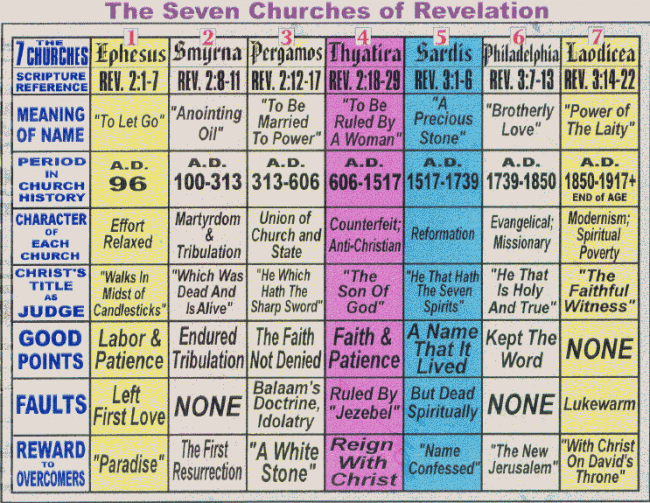
While this interpretation is widespread in Christendom, it has no Scriptural basis. It is fantasy. The seven “churches” in chapters 2 and 3 of Revelation are Jewish assemblies, not Christian churches. The language associated with them is wholly Jewish; no Pauline or Church language is present. Everything the Lord said was associated with Israel and concerned God’s judgment and how to obtain salvation during those seven years.
The Idealist school suffers from similar inadequacies. It is so broad and general in approach that it cannot provide helpful insight into the meaning of the events in the book other than to say that forces of good are at war with the forces of evil and that good will conquer evil.
For serious students of the Scriptures, only one interpretive school has hermeneutical rigor and merit: the Futurist. This method alone can integrate and interpret consistently the hundreds of Old Testament prophesies and the words of our Lord concerning end-time events (cf. Matthew 24).
Interpretive Methods
Another essential factor in understanding Revelation is its method of interpretation. Those who engage in a figurative hermeneutic wrestle the text into almost any shape they wish. For example, most who take a figurative approach of interpretation declare the two witnesses of Revelation 11 are the Church. This is pure imagination. Nothing in the context of the passage would lead to this conclusion. A normal reading of the text is that the two witnesses are just that, two witnesses, i.e., two men whom God will use during those days.
Much of the language in Revelation is figurative or symbolic. So are passages in Isaiah. Isaiah wrote, “all flesh is grass.” Did he mean skin is bermuda, zoysia, or fescue? Everyone recognizes Isaiah was using a figure of speech to communicate our bodies are mortal. The literal point remains: life ends, we die. The text will usually indicate when a passage is a figure of speech by its context or the use of “like” or “as.” In other cases, when symbolic language is used, one can understand the literal sense behind the symbol. In Revelation, we know the Lamb is Christ. We know the Beast is the Antichrist, the one who comes in the place of Christ and opposes Him. This is straightforward. In the same way, who are the two witnesses? The most natural interpretation is the two witnesses are two men God has commissioned as servants to reveal Him and oppose the Antichrist. In other words, the two witnesses are two witnesses. Lastly, since Revelation is a Jewish book, many of the symbols in the text allude to events and language of the Old Testament. The meaning of such passages can be found by comparing Scripture with Scripture.
If one is open to a normal reading of the text and will allow the Scriptures to speak plainly, Revelation is quite forthright. Only when one applies a non-literal interpretive method and tries to identify events to past history or impose ideological constructs or theological presuppositions does it become complex, difficult, and unverifiable.
Structure of the Book (Governed by Groups of 7)
| Introduction and the Seven Assemblies | Revelation 1-3 |
| Praise of God | Revelation 4 |
| The Seven Seal Judgments | Revelation 5-6 |
| Sealing 144,000 Jews of 12 Tribes of Israel | Revelation 7 |
| The Seven Trumpet Judgments | Revelation 8-9 |
| The Seven Thunders | Revelation 10 |
| The Two Witnesses | Revelation 11 |
| War in Heaven and Earth | Revelation 12 |
| The Beast and the False Prophet | Revelation 13 |
| The Six Angels and the Son of Man | Revelation 14 |
| The Seven Bowl Judgments | Revelation 15-16 |
| Babylon: World System of Satan | Revelation 17-18 |
| The Return of the King | Revelation 19 |
| The Judgment of Unbelievers | Revelation 20 |
| The New Heavens and New Earth | Revelation 21 |
| Concluding Words and Warnings | Revelation 22 |
Audience
Everything in Revelation concerns Israel and the nations. The Tribulation is the “time of Jacob’s trouble” (Jeremiah 30.7) and God’s judgment of the nations. Paul wrote the Church, the body is Christ, would not go through the wrath of the Day of the Lord (1 Thessalonians 1.10, 5.1-9; 2 Thessalonians 2.1-15; Romans 5.9; Ephesians 5.6; Colossians 3.6). Therefore, no Church language of evidence of the Church is present in Revelation. Paul warned that those who teach the Church will go through the Tribulation were false teachers (2 Thessalonians 2.1-2).
The primary audiences of Revelation are Jews who belong to the seven ἐκκλησίαι, “churches,” “assemblies,” “congregations,” etc., identified in the second and third chapters of Revelation (cf. Revelation 1.4-5). Notice each assembly did not just receive the message written to it but received the letters of all the assemblies (Revelation 1.4, 2.7, etc.). Each received all the messages. Why these seven? Why are they only in Turkey? Why are none in Israel? No one knows. The best answer may be that these believers were the same Jews to whom James and Peter wrote (James 1.1; 1 Peter 1.1). Only three of the seven cities of the assemblies are mentioned outside of Revelation: Ephesus (Acts 18.19, 21, 24, 19.1, 17, 26, 35, 20.16, 17; 1 Corinthians 15.32, 16.8; Ephesians 1.1; 1 Timothy 1.3; 2 Timothy 1.18, 4.12), Thyatira (Acts 16.14), and Laodicea (Colossians 2.1, 4.13, 15, 16). The other four are not mentioned.
The three assemblies mentioned are clearly different from the churches associated with Paul’s ministry. The language surrounding them is wholly Jewish and vastly different from the language Paul used in writing to members of the body of Christ. Paul’s language of grace, peace, the cross, resurrection, the body of Christ, etc. does not exist in these passages. Rather, the messages are of judgment, works, repentance, overcoming, etc. Each message contains the Lord’s familiar refrain “he that has an ear” from the gospels (Matthew 11.15, 13.9; Mark 4.9; Luke 8.8). Members of these assemblies were not saved by believing Paul’s gospel of the grace of God (Acts 20.24; Romans 16.25; 1 Corinthians 15.1-4). Those composing the ἐκκλησία of Revelation were Jews who believed the gospel of the kingdom. They had believed who Christ was (Matthew 16.15-16; John 11.25-27)–in His identity.
The Lord Himself communicated to these assemblies. The allusions and symbols are Jewish and the passages read like texts from the prophets. Revelation could snap into the Biblical canon right after Zechariah or Malachi and we would think nothing of it. John wrote to those who were “kings and priests” (Revelation 1.6). Members of the Church, the body of Christ, are never described as “kings and priests.” “Kings” and “priests” are designations of Jews (cf. Exodus 19.6; Matthew 19.28; 1 Peter 2.5, 9; Revelation 5.10).
The occasion or timeframe of the book is the Day of the Lord. John wrote he was in the Spirit on the Lord’s Day or the Day of the Lord: ἐν τῇ κυριακῇ ἡμέρᾳ (Revelation 1.10). Clearly, he did not mean Sunday. What John recorded were events that would fulfill the prophecies of the prophets concerning this day (Isaiah 2.12; 13.6, 9; Ezekiel 13.5, 30.3; Joel 1.15, 2.1, 11, 31; 3.14; Amos 5.18, 20; Obadiah 1.15; Zephaniah 1.7, 14; Zechariah 14.1; Malachi. 4.5 cf. Revelation 6.17; 16.14)3
The Lord communicated directly to John to them (Revelation 1.4, 11) and warned about events that would soon (τάχος) occur (Revelation 1.1, 22.6) and were “at hand” ἐγγύς (Revelation 1.3, 22.10). The word τάχος (from which we get tachometer) means either (or both) something that will happen soon or something that will happen speedily. The word ἐγγύς means to be near either (or both) in time or place.
To make their case, Preterists place enormous weight upon the terms τάχος and ἐγγύς. They argue the events recorded in Revelation occurred by 70 A.D. While difficulties exist in explaining the terms outside of the 70 A.D. framework, they are trivial compared to explaining the events within a 70 A.D. framework. Consider the following: Zephaniah wrote the Day of the LORD (the Tribulation) was near (קָרוֹב) in Zephaniah 1.14. The Hebrew word קָרוֹב corresponds to the Greek word ἐγγύς and means near in time or place. How near was the Day of the LORD to the prophets? Zephaniah wrote in the 6th century B.C. Joel wrote that the Day of the LORD was near קָרוֹב (Joel 2.1) in the 9th century B.C. So what is “near?” Near for whom? How is the problem of “near” solved? That is another story and the subject of a future article.4
Date
Most commentators maintain Revelation was written about 95-96. Evidence for such dating is highly problematic. The primary evidence for dating Revelation during Domitian’s reign (95-96) comes from Irenaeus. But what Irenaeus meant by what he wrote is unclear. Furthermore, Irenaeus’ reliability is questionable. For example, he stated Jesus was over fifty when he died (Adversus haereses, 2:22). Irenaeus specific quote for a late date is the following:
“We will not, however, incur the risk of pronouncing positively as to the name of Antichrist; for if it were necessary that his name should be distinctly revealed in this present time, it would have been announced by him who beheld the apocalyptic vision. For that was seen no very long time since, but almost in our day, towards the end of Domitian’s reign” (Adversus haereses, 5:30:3).
More likely, John wrote between 50-55 A.D., during the reign of Nero. Preterists maintain the events of Revelation were fulfilled by 70 A.D. So their theological position requires on early dating. Some have argued against Preterism on the basis of a later dating of the text (95-96 A.D.) but this approach is unnecessary. Prophecy is future. Revelation could easily have been written prior to 70 A.D. and have its fulfillment far in the future.
The great hurdle that exists for those who maintain the book was written late (95-96 A.D.) is no mention is made of the destruction of Jerusalem and the Temple in 70 A.D. To the Jew, Jerusalem and the Temple were everything. Not to mention their destruction in a book like Revelation would be like an American history text failing to mention the Civil War or WW2. J. A. T. Robinson commented on this matter in his book Redating the New Testament:
One of the oddest facts about the New Testament is that what on any showing would appear to be the single most datable and climactic event of the period–the fall of Jerusalem in A.D. 70, and with it the collapse of institutional Judaism based on the temple–is never once mentioned as a past fact. It is, of course, predicted; and these predictions are, in some cases at least, assumed to be written (or written up) after the event. But the silence is nevertheless as significant as the silence for Sherlock Holmes of the dog that did not bark. S.G.F. Brandon made this oddness the key to his entire interpretation of the New Testament: everything from the gospel of Mark onwards was a studied rewriting of history to suppress the truth that Jesus and the earliest Christians were identified with the revolt that failed. But the sympathies of Jesus and the Palestinian church with the Zealot cause are entirely unproven and Brandon’s views have won scant scholarly credence. Yet if the silence is not studied it is very remarkable.
James Moffatt wrote:
We should expect . . . that an event like the fall of Jerusalem would have dinted some of the literature of the primitive church, almost as the victory at Salamis has marked the Perae. It might be supposed that such an epochal-making crisis would even furnish criteria for determining the dates of some of the NT writings. As a matter of fact, the catastrophe is practically ignored in the extant Christian literature of the first century.
Similarly, C.F.D. Moule wrote:
It is hard to believe that a Judaistic type of Christianity which had itself been closely involved in the cataclysm of the years leading up to A.D. 70 would not have shown the scars–or, alternatively, would not have made capital out of this signal evidence that they, and not non-Christian Judaism, were the true Israel. But in fact our traditions are silent.
The book of Revelation is the last book of the Bible in our canon for good reason. It is the final expression of and complement to the prophecies of the Jewish prophets. Revelation reveals the events of the Day of the LORD (Revelation 1.10; Zephaniah 1.14-18; Joel 2.1-11; Acts 2.14-21), what Jesus called the “Tribulation” (Matthew 24.21, 29) and the establishment of the kingdom of God upon the earth.
Theme and Purpose
Survival in the Tribulation will be almost impossible.
Jesus provided His disciples with details about the end-time and His return (Matthew 24). His chief warning to them in His Olivet discourse was that they should not be deceived (πλανάω) (Matthew 24.4, 5, 11, 24). The reason Jesus gave this warning was that deception will characterize the Day of the LORD (the Tribulation). The book of Revelation is the record of Satan’s great attempt as the “god of this world” (2 Corinthians 4.4) to rule overtly the world he now controls behind the scenes (Matthew 4.8-9; Luke 4.5-6). Satan has manipulated the world’s governments for thousands of years as a great puppet master and will finally step from behind the curtain onto the world stage in the person of the Antichrist a.k.a. “the Beast” to rule (1 John 2.18; Revelation 13.1-4). Jesus prophesied about him in John 5 and issued a chilling warning about how the Jewish people (and the world) will respond to this deceiver.
39 You search the Scriptures because you think that in them you have eternal life; it is these that testify about Me; 40 and you are unwilling to come to Me so that you may have life. 41 I do not receive glory from men; 42 but I know you, that you do not have the love of God in yourselves. 43 I have come in My Father’s name, and you do not receive Me; if another comes in his own name, you will receive him (John 5.39-43).
Jesus declared to the Jews who opposed Him that He came in His Father’s name. He told them that while they refused to receive Him, they would receive “another” who would come in his own name. This will be Satan’s man, the Antichrist, the Beast (cf. John 5.43).
A Guide For Survival
Revelation is a survival manual. Beyond revealing the King, the Lord Jesus Christ, and the events that will transpire until His return, its primary purpose is a survival guide. In His Olivet message, Jesus declared the Tribulation period would be a time of extraordinary deceit. This deception will be to such a degree that even believers may be deceived:
24 For false Christs and false prophets will arise and will show great signs and wonders, so as to mislead, if possible, even the elect. 25 Behold, I have told you in advance (Matthew 24.24-25).
Jesus made it clear that this period of time will also be a time of unprecedented distress:
9 Then they will deliver you to tribulation, and will kill you, and you will be hated by all nations because of My name. 10 At that time many will fall away and will betray one another and hate one another. 11 Many false prophets will arise and will mislead many. 12 Because lawlessness is increased, most people’s love will grow cold. 13 But the one who endures to the end, he will be saved. 14 This gospel of the kingdom shall be preached in the whole world as a testimony to all the nations, and then the end will come (Matthew 24.9-14).
The Lord warned His disciples of coming tribulation with death and hatred because of Him. People (believers included?) will abandon the faith and betray and hate one another. False prophets will be everywhere and crime rampant. Jesus warned, “the one who endures to the end, he will be saved.” This is a key phrase and has reference to what the Lord told John to write to the Jewish assemblies about “overcoming.” The gospel of the kingdom will reach the entire world and then the end (the return of the King) will come. Finally, each address to these assemblies includes the words, “He who has an ear, let him hear what the Spirit says to the churches” (Revelation 2.7, 11, 17, 29, 3.6, 13, 22). This mirrors the seven times Jesus spoke these words in the Gospels (Luke 8.8; Matthew 11.15, 13.9, 43; Mark 4.23, 7.16; Luke 14.35). The eighth usage of this adage occurs in Revelation 13.9. The significance of this occurrence is that it sums up the earlier seven warnings and explains these warnings concern the worship of the Beast and the Dragon (Satan) who empowers him.
The words Jesus gave His disciples about enduring to end is the central message to the seven Jewish assemblies in Revelation.
| Assembly | Message: Overcome (νικάω) |
| Ephesus | To him who overcomes, I will grant to eat of the tree of life which is in the Paradise of God (Revelation 2.7). |
| Smyrna | He who overcomes will not be hurt by the second death (Revelation 2.11). |
| Pergamum | To him who overcomes, to him I will give some of the hidden manna, and I will give him a white stone, and a new name written on the stone which no one knows but he who receives it (Revelation 2.17). |
| Thyatira | 26 He who overcomes, and he who keeps My deeds until the end, TO HIM I WILL GIVE AUTHORITY OVER THE NATIONS; 27AND HE SHALL RULE THEM WITH A ROD OF IRON, AS THE VESSELS OF THE POTTER ARE BROKEN TO PIECES, as I also have received authority from My Father; 28 and I will give him the morning star (Revelation 2.26-28). |
| Sardis | He who overcomes will thus be clothed in white garments; and I will not erase his name from the book of life, and I will confess his name before My Father and before His angels (Revelation 3.5). |
| Philadelphia | He who overcomes, I will make him a pillar in the temple of My God, and he will not go out from it anymore; and I will write on him the name of My God, and the name of the city of My God, the new Jerusalem, which comes down out of heaven from My God, and My new name (Revelation 3.12). |
| Laodicea | He who overcomes, I will grant to him to sit down with Me on My throne, as I also overcame and sat down with My Father on His throne (Revelation 3.21). |
The message Jesus gave to the members of each assembly was a message of salvation, i.e., “eat of the tree of life,” “not hurt by the second death,” etc. Nothing in Jesus’ words indicate that the members of these assemblies had salvation as a present possession. He said, “I will grant/give” (δώσω–future active indicative) salvation to those who “overcome.” Such language is entirely different from Paul’s teaching that believers “have” salvation as a present possession on the basis of believing his gospel (cf. 1 Corinthians 15.1-4; Ephesians 1.7; Colossians 1.13-14). For those whom Jesus addressed in Revelation 2-3, salvation is based upon “overcoming.” If they “overcome” they will (future tense) be saved.
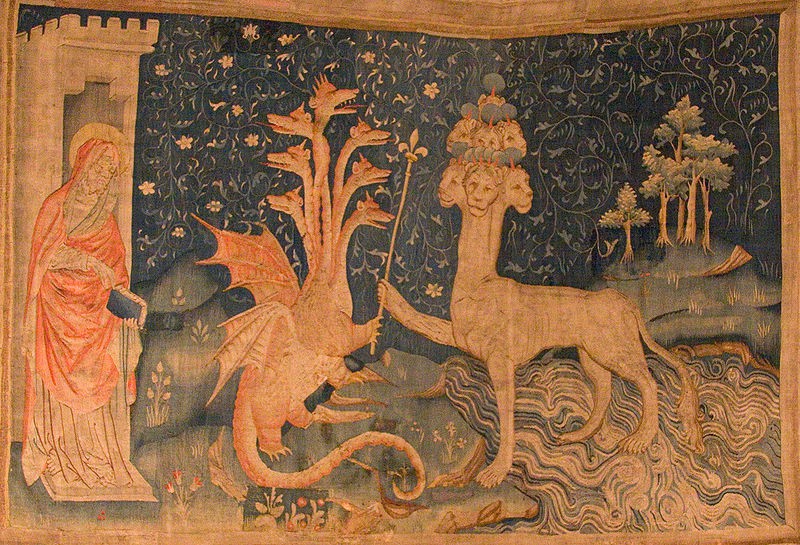
La Bête de la Mer (from the Tapisserie de l’Apocalypse in Angers, France). This detail shows the False Prophet, the Dragon, and the Beast of the Sea.
What constitutes “overcoming” (νικάω) to obtain salvation? The challenge for the generation in which these events will occur will be a choice: to trust the true Christ or embrace the false Christ. Jesus warned of the tremendous pressure that will be exerted to earth’s inhabitants to worship and identify with the false Christ. John witnessed that “all who dwell upon the earth will worship him” (Revelation 13.8) and that none can buy or sell without accepting his identifying mark (Revelation 13.16-17). Worship of and accepting the Antichrist’s mark will constitute a rejection of Christ and seal one’s eternal doom (Revelation 14.9-11). Such language presents an impossible hurdle for preterists and historicists since this has never happened. It remains future.
The “enduring until the end” of which Jesus spoke referred to one of two outcomes: the end of a person’s life–being executed for not worshiping the Antichrist and accepting his mark–or Christ’s return at the end of the Tribulation. The one who endures to the end is the one who overcomes. By “saved” Jesus meant both eternal salvation and physical salvation.
Another thing to note from the Matthew 24 passage is that the “gospel of the kingdom” will be preached during the end time. This gospel was the good news John the Baptist, Jesus, and the Twelve proclaimed: that Christ was the Messiah-King. It declared the King and His kingdom were near (Matthew 3.3, 4.17, 23, 9.35). Under the kingdom gospel one was saved by believing Jesus was the Messiah, the Son of God (Matthew 16.15-16; John 11.26-27). This gospel will be revived and preached again during the Tribulation period. Believing Jesus is the Messiah, the Son of God, means one will reject the Beast, the Antichrist as God–worshiping and taking his mark.
Conclusion
The book of Revelation serves strategic and tactical purposes. The strategic purpose is to reveal Christ, His return, the setting up of His kingdom, the defeat of Satan, and the establishment of the eternal state (new heavens and new earth). The tactical purpose, which is most of the book, is to reveal the horrors of the Tribulation and how one can be saved in the midst of tremendous deception and pressure.
1 Dating is based on several factors. The most explicit statement for the dating of the book is Colossians 1.25. Paul wrote that God gave him the job of completing the Scriptures. Since Paul died around 67-68 A.D., it means 2 Timothy was the last book written. This eliminates the prevalent idea that Revelation was written in the 90s. John thought the coming of Christ was near (Revelation 1.1) as did Peter (Acts 2.16-21), as did Paul. Paul thought the Rapture would occur in his lifetime and the Day of the Lord would follow shortly. While the stoning of Stephen was the crisis point for national Israel, God let Israel’s rejection run its course for 40 years (the biblical time of testing) until Titus destroyed Jerusalem (70 A.D.). Had Israel repented, the Tribulation would have occurred during the reign of Nero, who would have fulfilled the requirements of the Antichrist. One of the cities John addressed was Laodicea, which was destroyed (along with Colossae and Heiropolis) in the mid-60s A.D. This would seem to indicate he wrote before then. Paul mentioned believers in both of these cities in his letter to the Colossians, but neither Colossae or Heirapolis is mentioned in Revelation. About 60 A.D., Paul made his last appeal to Israel (Acts 28). In 51 A.D., the Jerusalem Council agreed Paul’s gospel was the only valid gospel from then onward. Thus, this meeting marked the end of the gospel of the kingdom proclaimed by the Twelve (Acts 15.11, cf. Galatians 1.6-9). John wrote of future events, which would indicate before Nero, who reigned from 54-68 A.D. What he wrote would have had to be before or within his reign, i.e., probably before 54 and before Laodicea was destroyed. John gave no indication of the decision of the Jerusalem Council. He recorded the words of Jesus that salvation was based upon “overcoming” (νικάω, cf. Matthew 24.13-14), through the gospel of the kingdom, not Paul’s gospel of grace. No Church, body of Christ, doctrine exists in Revelation or doctrines proclaimed by Paul. This seems to indicate John wrote Revelation before Pauline doctrine was assimilated (cf. 2 Peter 3.14-16). Lastly, is the matter of the Temple, destroyed in 70 A.D., discussed above.
2 E.W. Bullinger, Commentary on Revelation, p. 154.
3 The predominant view is the that “Lord’s day” referred to Sunday. However, a strong minority view has favored that the phrase meant the “day of the Lord” or the “day of Yahwe,” cf. Revelation 6.17, 16.14 (Encyclopedia Biblica, s.v. “Lord’s Day”). J. A. Seiss wrote: He says he “was in Spirit in the Lord’s day,” in which he beheld what he afterward wrote. What is meant by this Lord’s day? Some answer, Sunday—the first day of the week; but I am not satisfied with this explanation. Sunday belongs indeed to the Lord, but the Scriptures nowhere call it “the Lord’s day.” None of the Christian writings, for 100 years after Christ, ever call it “the Lord’s day.” But there is a “Day of the Lord” largely treated by prophets, apostles, and fathers, the meaning of which is abundantly clear and settled. It is that day in which, Isaiah says, men shall hide in the rocks for fear of the Lord, and for the glory of his majesty;—the day which Joel describes as the day of destruction from the Almighty, when the Lord shall roar out of Zion, and utter his voice from Jerusalem, and the heavens and the earth shall shake;—the day to which the closing chapter of Malachi refers as the day that shall burn as an oven, and in which the Sun of Righteousness shall arise with healing in his wings;—the day which Paul proclaimed from Mars’ Hill as that in which God will judge the world, concerning which he so earnestly exhorted the Thessalonians, and which was not to come until after a great apostasy from the faith, and the ripening of the wicked for destruction;—the day in the which, Peter says, the heavens shall be changed, the elements melt, the earth burn, and all present orders of things give way to new heavens and a new earth;—even “the day for which all other days were made.” And in that day I understand John to say, he in some sense was. In the mysteries of prophetic rapport, which the Scriptures describe as “in Spirit,” and which Paul declared inexplicable, he was caught out of himself, and out of his proper place and time, and stationed amid the stupendous scenes of the great day of God, and made to see the actors in them, and to look upon them transpiring before his eyes,that he might write what he saw, and give it to the Churches. This is what I understand by his being “in Spirit in the Lord’s day.” I can see no essential difference between ἡ Κυριακη ἡμερα—the Lord’s day, and ἡ ἡμερα Κυριου—the day of the Lord. They are simply the two forms for signifying the same relations of the same things” (J. A. Seiss, The Apocalypse: Lectures on the Book of Revelation). A good study of the subject is Ranko Stefanovic’s “The Lord’s Day” of Revelation 1:10 in the Current Debate, Andrews University Seminary Studies, Vol. 49, No. 2, 2011, pp. 261-284.
4 See the author’s study, How “Near” is the Day of the Lord?
©2013 Don Samdahl. Anyone is free to reproduce this material and distribute it, but it may not be sold.

Don,
I was taught that Israel was to be the Kingdom of Priests. Rev. 5 vs 9&10 mentions believers from every tribe, language and people and nations are made a kingdom of priests and they will. Reign on earth. Please comment. thank you
ps I heard this on YouTube from a replacement theory theologian.
Joe,
John wrote to Jews. He is speaking about Jews. While the Tribulation affects the entire world (God’s prophetic program concerns Jews and Gentiles, but not the Church), Jews are John’s primary audience. One of God’s great promises to them is they will be a kingdom of priests. One cannot transfer this promise to Gentiles. I would suspect the replacement fellow also sees the Church in Revelation.
Who is the “synagogue of Satan” mentioned in Revelations 2:9 and 3:9
Cigmd,
Both references describe it as “those who say they are Jews and are not.” This refers to Jewish false teachers, those who were biologically children of Jacob but were unbelievers. Jesus identified these in John 8.
Hi Don,
I have been a regular visitor to your site because I find your Rightly Dividing articles very rich and insightful. In fact, they have helped me to strengthen my understanding of the Bible and shifted some of my earlier stands on certain grey areas such as the authorship of Hebrews and the date of the Book of Revelation among others.
However, I wish to know whether you have written articles on the Eternal State and the New Jerusalem as well as what you think might be the scenario at the Judgment Seat of Christ since I have not seen those on the list of articles – maybe you are working on them now or you intend to do that later based on request.
Thank you for the good work you are doing to help the Body of Christ.
Emmanuel,
Little is known of the eternal state, hence no article. The judgment seat of Christ is on the Day of Christ, when Christ judges the works of members of the Church (1 Corinthians 3.10-15).
Don…You may have answered this elsewhere, but I still need to ask: Why was the Gospel of the Kingdom reinstituted during the Tribulation if Paul’s Gospel is the one that ‘saves’? Can Jewish people be saved through believing the Gospel of the Kingdom?
Dean,
The only valid gospel today is Paul’s gospel. See my article, The Great Hinge. The gospel of the kingdom will return in the Tribulation (Matthew 24.14). Its focus is on Christ’s identity. The great question to show faith in the Tribulation will be God’s identity. The Beast claims to be God. Is the Beast God or is Jesus of Nazareth? All who accept the Beast’s mark worship him as God. Not to accept the Beast’s mark means the opposite. This is what Jesus meant when He spoke about saving one’s life, losing it, losing ones life and saving it. Accepting the Beast’s mark saves one’s life but loses eternal life. Rejecting his mark loses one life (one is executed) but gains eternal life.
So, in the Tribulation, people can be ‘saved’ by believing that Jesus is the Messiah (believing in Jesus, rather than the Beast)? If Jews can be saved by acknowledging the identity of Jesus, then why can’t they be saved that way today?
Dean,
Because Peter said so. Read Acts 15. Because Paul said so. Read Galatians 1.6-9.
Hi Don
The even In revelation 12 vs 6 and 14 are they the same or different event
Gideon,
Same event. They obey what Jesus told the Jews to do when they see the abomination of desolation (Matthew 24.15-16). God will supernaturally speed them to safety even as He sped the Jews through the Red Sea away from Pharaoh (Exodus 19.4).
What did Paul mean 1cor 5:5
Is he talking about salvation or something else, when he said :that his spirit may be saved on the day of the Lord
Secondly Is the day of the Lord as use here means the rapture or the tribulation
Thank you
Gideon,
The man was a believer. Paul judged that he be turned over to Satan to kill him due to his sin. This was so he might not lose reward and status with God and that his sin might not harm the reputation of the Church. It is better to die than to continue to dishonor the Lord. The “salvation” Paul mentioned was not salvation from sin (the man had that) but salvation in the sense of saving his reward. The expression, “the day of the Lord Jesus” is the day of Christ, the Rapture, not “the day of the Lord,” the Tribulation. Happily, the man repented and was restored according to 2 Corinthians. The Lord does take out sinning believers at times (cf. 1 Corinthians 11.30).
“ all members of the Church, whether dead or alive, participate” (in Rapture)
Confused. I thought deceased believers were judged at death and are already in heaven. Where are deceased people such as our parents and ancestors? Thanks.
DJ,
Deceased believers (soul and spirit) are in heaven. Their bodies remain on earth. God’s judgment does not occur for all at the same time. No judgment occurs until humans have resurrection bodies. None do except those resurrected after Jesus’ resurrection (Matthew 27.50-53).
Confused still. I thought we were judged upon death. How can a soul be in heaven if it wasn’t judged? So is there a second judgement with the resurrection body?
Are there any dead people who haven’t been judged? Thanks
DJ,
Only believers are in heaven. Our sins were judged on the cross. Jesus paid for our sins, was punished for our sins. The judgment of believers is for our works, for rewards. All unbelievers are in hell for they rejected Christ’s payment for their sins. They await final judgment, public judgment, at the Great White Throne (Revelation 20.11-15).
So, for instance, an atheist, Muslim, Jew, or Hindu who died is in Hell. Then they later get judged at the Great White Throne. Can you describe what that’s like, what happens, and then where do they go after? Thank you
DJ,
Please read Revelation 20.
Hello: Read Chapter 20. So, if I understand, the non-believers are brought out of Hell and judged a second time at the Great White Throne? What has changed in between that would make the second judgement any different from the first one when they died?
“The judgment of believers is for our works, for rewards.” The believers are in heaven, then get resurrection bodies and then get judged a second time for rewards and then go back to heaven? Is this right?
Thank you
DJ,
What has changed is that the GWT is a public judgment and the sentence is eternal punishment. God will demonstrate to believers, unbelievers, and the angelic host that He is righteous, just, and fair in His decree of eternal punishment. God will judge members of the Church for rewards at the Rapture after all its members receive resurrection bodies. God will judge believers outside of the Church for rewards presumably when they receive resurrection bodies.
Thank you for your due diligence these clarifications and confirmations are very helpful and a great resource for answering questions.
RF,
Thank you.
Imagine the deception the following might have caused in the years leading up to and into WWII.
Take the English alphabet. Assign to the letter A-100, B-101, C-102 etc.
H = 107
I = 108
T = 119
L = 111
E = 104
R = 117
Add the numbers——-666
Don, do you believe the number 666 is literal or figurative as it’s presented in the book of Revelation?
Joe,
It is literal but will not be understood until the mid-point of the Tribulation.
Pingback: "What Is the Book of Revelation Really About? A Christian’s Guide" - amen.quest
Pingback,
If your “A Christian’s Guide” is worth anything you should have mentioned that if you are a “Christian” (Paul’s definition, 1 Cor. 15.1-4) you wouldn’t be present to experience the majority of the REVELATION account. Despite your “Guide”, you must understand that REVELATION has nothing in it directly addressing “the church of God”, “the body of Christ” (1 Cor. 10.32, 12.27). Paul wrote “the Church” would not go through “the wrath to come” of “the day of the Lord” (1 Thess. 1.10; 2 Thess. 2.1- 12; Rom. 5.9; Eph. 5.6; Col. 3.6), the overarching theme of REVELATION. This may point to the fact that God has already “removed” (“ἁρπάζω”/ “seized”/ “raptured”, 1 Thess. 4.17) “the Church” before any of the future events John witnessed and recorded… a convincing reason why “the Church’s” language is not present in REVELATION.Trying to jam “the church of God”, “the body of Christ” (1 Cor. 10.32, 12.27), into REVELATION is just that… wrenching (2 Peter 3.16) to fit a square peg into a round hole. Paul warned that those who teach that “the Church” will go through “the day of the Lord” are “deceivers” (2 Thess. 2.1-3). I find it hard to believe that you even took the time to read this timely article.
It is amazing to me how two simple sentences can be understood with two totally opposite views. My understanding of IIThess.2:1-4 is exactly the opposite. And the reason is because you folks change the recorded Word of God, you think that Paul meant the day of the Lord, when he clearly stated the day of Christ. In the first sentence Paul is speaking of the Rapture, which will occur in the day of Christ, not the day of the Lord. Don’t change the words, and you realize the first sentence is only about the Rapture. Then deal with the second sentence, then you realize, both the stipulations set forth by Paul must manifest before we are Raptured; the falling away, and the abomination of desolation. What gives any person the right to change Scripture?
Daniel,
Your error is because you believe the KJV is infallible. I gave you a massive amount of evidence showing it is not. The KJV is a translation. Its authors wrote that it was not infallible. The only infallible text were the autographs. If one does not understand this, how we have our Bible, one is going to make theological errors. Far greater manuscript evidence exists for “day of the Lord” rather than “day of Christ.” The problem Paul was addressing was that some were teaching the Thessalonians that the persecutions they were experiencing indicated they were in the day of the Lord. Paul wrote to assure them that they were not in the Tribulation because the Rapture must occur first. The “gathering together” in verse 1 is parallel and synonymous with how the KJV translated “falling away” in verse 3. This is a poor translation as previous translations rendered it as “departure.” Paul clearly stated that the Rapture, our gathering, our departure, must occur before the man of sin appears. It is pointless to argue further.
Amen.
The only Scripture without error are the autographs; and the copies, to the extent that they perfectly translate and match the autograph.
“Forever, O LORD, your word is settled in heaven.”
Daniel,
The articles on this site have helped probably untold numbers of “believers” out of the confusion that the Christian “religion’’ fails to address. Sloppy doctrine. Not just the articles are well constructed… don’t miss the footnotes:
“The KJV reads “day of Christ” (2 Thess. 2.2). The KJV is based largely upon the Majority text which along with the second corrector of D, read D2, (9th century) reads “Day of Christ” instead of “Day of the Lord.” Earlier evidence in all forms (Greek, versions, fathers) supports the text “Day of the Lord.” Such a reading also fits Paul’s theology for he taught that we are not “appointed unto wrath” (judgment, i.e., the Day of the Lord, cf. 1 Thessalonians 1.10, 5.9) since the Body of Christ will be removed from the earth before the appearance of the Antichrist and God’s judgment. Paul’s usage of ἐνίστημι in 2 Thessalonians 2.2. Paul used this term in Romans 8.38; 1 Corinthians 3.22, 7.26; Galatians 1.4; 2 Thessalonians 2.2, 2 Timothy 3.1; Hebrews 9.9. In almost every instance he used it to mean things “present.” In the first two usages he distinguished it from future occurrences (οὔτε ἐνεστῶτα οὔτε μέλλοντα; εἴτε ἐνεστῶτα εἴτε μέλλοντα). Thus, a reading of “day in Christ” would read, “That ye be not soon shaken in mind, or be troubled, neither by spirit, nor by word, nor by letter as from us, as that the day of Christ is present.” Such a reading does not make sense. They knew the day of Christ (Rapture) had not taken place because they were still there. The question they had (and were being taught by false teachers) was whether they were experiencing the day of the Lord. Paul wrote 2 Thessalonians to correct this false teaching. Thus, the correct reading is “That ye be not soon shaken in mind, or be troubled, neither by spirit, nor by word, nor by letter as from us, as that the day of the Lord is present (or has come).” See the companion study on the Rapture and on 1 and 2 Thessalonians.”
Let’s make it a little simpler. Is the first sentence about the Rapture, or not? II Thess. 2:1-2 Now we beseech you brethren by the coming of our Lord Jesus Christ, and by our gathering together unto him, that ye be not soon shaken in mind, or be troubled, neither by spirit, nor by word, nor by letter as from us, that the day of whatever is at hand. Why, yes Dan, it is only about the Rapture. Seeing when you break it down this way, the second sentence clearly states that day shall not come except two separate events take place first. So, the stand you are taking is the Rapture, which is the first of the stipulations, must occur before the Rapture. How does this make any sense at all?
Daniel,
Verse 1 “gathering” is the same as verse 3, “departure.” The gathering and departure (KJV, “falling away”) come before the day of the Lord. The KJV “at hand,” ἐνέστηκεν, better means “present.” This is the way the KJV translators rendered it in Romans 8.38; 1 Corinthians 3.22, 7.26; Galatians 1.4. Only Paul used this verb, ἐνίστημι, and he always used it with the sense “present.” Why the KJV translators rendered it “at hand” is unknown. It is a poor translation. So the text reads, “the day of the Lord is present” (or has arrived). The Thessalonians were being told they were in the Tribulation. Paul wrote, gave them a sure sign this was not the case. The confirming sign was the Rapture. They would not be present when the Tribulation began. They would be gone before the man of the sin (or man of the lawlessness), the Beast, appeared.
Whether you call it falling away, or departure, it means leaving your faith behind, and wow, have we ever witnessed this unfolding event in our lifetime. The first stipulation has already manifest, now we only require the abomination of desolation.
Daniel,
You are missing Paul’s point. Falling away, apostasy is always present. The Thessalonians were being taught by apostates. Apostasy, rebellion, falling away is not a sure sign. The Rapture is. That was Paul’s mission, to give them a concrete sign that they were not in the day of the Lord. The Rapture is that sign. “Departure” here means a physical removal from earth, what Paul declared in 1 Thessalonians 1.10.
Daniel,
If you don’t trust what the author of this site teaches concerning 2 Thess. 2.2, look further to other sources to confirm what he has taken the time to articulate. Here is what comes from a site entitled “Biblical Hermeneutics”.
“There is a textual variant in 2 Thessalonians 2.2. The Byzantine text-type follows the variant that says χριστου, ‘CHRIST’. Codex Claromontanus from the Western text-type also contains this variant. ALL OTHER MANUSCRIPT TRADITIONS FOLLOW THE VARIANT THAT SAYS ‘κυριου’, ‘LORD’. The Byzantine text-type represents a manuscript tradition that ranges from the FIFTH TO THE SIXTEENTH centuries. The other two major text-types come from EARLIER PERIOD: the Western text-type from the THIRD TO THE NINTH centuries, and the Alexandrian text-type from the SECOND TO THE FOURTH centuries. However, because the Byzantine text-type represents such a huge span of time (i.e. FIFTH TO THE SIXTEENTH centuries), and is more recent, it comprises the vast majority of known manuscripts; hence, it is also called the Majority Text. In the early sixteenth century, 1516, the Textus Receptus (‘Received Text’) was produced, a printed Greek New Testament. The Textus Receptus was BASED LARGELY ON THE BYZANTINE TEXT-TYPE.
Textus Receptus 1519:
2 Thess 2.2 in Textus Receptus, AD 1519
ἡ ἡμέρα τοῦ Χριστοῦ
‘the day of the Christ’
About a century later, the King James Version was produced, and the translators followed the Textus Receptus. Hence, THE KJV READS ‘CHRIST’ in 2 Thessalonians 2.2. After the KJV’s production, there were many developments in biblical scholarship; far too many to describe at any length here. The result, however, was a large shift that cast the reliability of the Byzantine text-type INTO DOUBT because its represented a LATER MANUSCRIPT tradition (i.e. 5th to 16th century). TO PUT IT BLUNTLY, EARLIER MANUSCRIPTS ARE GENERALLY SEEN AS MORE RELIABLE (i.e. 2nd & 3rd centuries). This was encapsulated in the Westcott-Hort text of the New Testament, which largely followed the Alexandrian text-type tradition. Here are two manuscripts from this text-type:
Codex Sinaiticus:
2 Thess 2.2 in Codex Sinaiticus, c. AD 330-360
Η ΗΜΕΡΑ ΤΟΥ ΚΥ (ἡ ἡμέρα τοῦ Κυρίου)
‘the day of the Lord’
Codex Vaticanus:
2 Thess 2.2 in Codex Vaticanus, c. AD 300-325
Η ΗΜΕΡΑ ΤΟΥ ΚΥ (ἡ ἡμέρα τοῦ Κυρίου)
‘the day of the Lord’
Note that ΚΥΡΙΟΥ (κυριου, ‘Lord’) is abbreviated as ΚΥ with an overline. This is a nomen sacrum.
By the twentieth century, most English translations were following Westcott-Hort. The NIV is one of them, so it follows the variant that says κυριου, ‘Lord’.”
Before putting all your marbles into the KJV bag please for yourself research what all went into the translation. There is a wealth of historical information to ponder. I’ve heard more times than I can number this site’s author saying that the KJV is a “good” translation. “Good” is not “perfect”.
Michael,
What would be your opinion in regards to Dean Burgon’s work in his “Revision Revised”?
It surely contains abundant historical data.
Thanks
Carla,
I will admit that I had to do some homework on “Dean John William Burgon”. He vehemently attacked the legitimacy of Westcott-Hort text of the New Testament. It seemed to be his obsession. He earned the nickname “the original KJV onlyist”. It was said of him that “we would have to use the KJV forever, even in heaven”. Keep in mind his work is now 150 years old. There have been many huge developments in biblical scholarship since then. Can you imagine us common folk having access to the Greek, in which the autographs were written, and at the touch of our fingers? I am in no ways learned in “textual criticism”. I did not set out to disprove the KJV “translation”. It was only when I stumbled upon contextual confusion did I discover translation shortfalls such as the KJV translators habitual use of one English word for multiple distinct Greek words. One has to ask “what was lost in translation”? Or employing an English word that never appeared in the original text (i.e. “church”). I truthfully can say that many of my findings has changed and enhanced my “doctrine”. I use the KJV translation the most because I have a parallel “Strong’s” where I can view a better rendering. The KJV is a “good” translation. It is not “perfect”, as all the other translations. Perfection is reserved for the autographs, the original documents, that were “divinely breathed and profitable for doctrine” (2 Tim. 3.16). It is one thing to “receive the word with all readiness of mind”, and another thing to “search the scriptures daily, whether those things were so” (Acts 17.11).
Michael,
Textual criticism is complex and certain textual variants are unsolvable. Textual critics have formulated rules by which to judge variants such as “the shorter reading is preferred,” “the more complex reading is preferred,” etc. The problem is applying a general rule to a specific passage. I see good arguments for both the Majority Text (MT), which the KJV is mostly based on, called the Received Text, and the Critical Text (CT). In my translation, I generally preferred the MT but noted variant readings. At the end of the day, they matter little. None of them change any basic doctrine. When something is left out, as in the CT, it is found elsewhere. We have a 1,000 piece puzzle with 1,020 pieces. We do not know what the right 20 pieces are and can never know until we get to heaven.
Your explanation is perfectly confusing, thank you.
Daniel,
The KJV translated “a falling away.” This is an error. The Greek text reads, “the falling away,” or better, “the departure,” as previous translations rendered it. The noun ἀποστασία has the definite article, ἡ ἀποστασία. Paul used the definite article to denote a specific event, “the coming of our Lord Jesus Christ,” “our gathering unto Him” in verse 1. “The departure” is that “gathering,” the Rapture.
I agree.
The ‘apostasia’ is best translated ‘departure’. It fits in with the context (verses 1-8), where a ‘falling away’ (as in, from Christian doctrine or the faith) does not fit into context; and, it is something that happens throughout this dispensation of the body of Christ.
2 Thes.2 has become my favorite chapter of Scripture proving a pre-tribulation Rapture(harpazo).
The last prayer of the bible says ‘Come, Lord Jesus.’
Amen.
My question remains the same, II Thess. 2:1-2, is this first sentence about the Rapture, or not?
Daniel,
How many times do you need an answer? Over and over I have answered. Verse 1 is the Rapture. Verse 2 is the Tribulation. Verse 3 is the Rapture.
Hi Don. I wonder if people realize that 1st and 2 Thess. were written early in Pauls letters(maybe Acts 18) when he was going to the Jew first . To me this is important to realize because the things 2 Thess. 2 have to do with are “Israel oriented”. They are in the OT and prophesied even by the Lord Jesus in the gospels. John.5:43 …and Judas Ischariot was called the son of perdition. The church which is Christs body was NOT KNOWN then in those times. Right?
I wonder too if people realize that these things regarding Israel and Christ’s return WERE CONITIONAL, based upon national repentence. The 12 going to their own in Jerusalem and Judea and Paul going out to the dispersion among the Gentiles! But when the SALVATION OF GOD WAS SENT to all nations in Acts 28 this would maybe have been their national ” sign” that His return would not be in their lifetime. So maybe Paul was their sign in that time. 2 Pet.3:15,16 (also he was the one born out of due time)
Its also of note to me that Christ’s COMING (parousia) is not mentioned in Eph./Col… But his APPEARING (phanaroo) is. (Col.3:4
We need so much to understand WHO WE ARE in the Bible. The fact someone would argue this stuff to such a degree, is plain that no consideration has been given to what 2 Thess. 2 is even talking about.
Its precious that you try to assist and also will pray that God would open understanding to all these things. Not trying to mix anything up but to maybe bring more light to the historical context of the passage itself. Its so obviously Israel oriented but some do not understand that there are different companies of people in Gods salvation. To me…. In that time Israel was diminishing but not yet cast away. Even Rom.11 looks to the future yet casting away. (Which happens in Acts 28:25, 28
Interesting too in Acts 28;25… “DEPARTED” Is “apolyo”… which means…
release (17x), put away (14x), send away (13x), let go (13x), set at liberty (2x), let depart (2x), dismiss (2x), miscellaneous (6x).
Strong’s Definitions: ἀπολύω apolýō, ap-ol-oo’-o; from G575 and G3089; to free fully, i.e. (literally) relieve, release, dismiss (reflexively, depart), or (figuratively) let die, pardon or (specially) divorce:—(let) depart, dismiss, divorce, forgive, let go, loose, put (send) away, release, set at liberty.
Much to think on. Love and grace to all ! 🙏🌅🤗
That is an answer I can understand. Your answer does not make sense, I don’t believe for a second that Paul changes from Rapture to Tribulation and back again, regardless of the changes you make to Scripture. Whether Paul meant what is recorded, or he meant the day of the Lord; neither would support the idea Verse 2 is about the Tribulation and Verse 3 is not. You know Paul never wrote about the Tribulation in his letters, why in your understanding does this change from Rapture to Tribulation, then back again? That idea goes right over my head. I pray President Trump and Prime Minister Netanyahu, who are meeting today, lay down the parameters for the covenant. That would be one way to answer our understanding differences, or better yet, you are correct, and we are redeemed any day now. For the record, I would rather you are correct, and I am in error, but the information I have gathered tells me the covenant will manifest before we are redeemed, and I also must add, we will not go through the Tribulation, we will be taken out of it, the day after the abomination of desolation.
Daniel,
I have explained all this in great detail, how false teachers were telling the Thessalonians they were in the Tribulation and Paul assured them they were not because the Rapture will remove them. You think the Church is present in the 7 year period because you do not understand that the Church is not part of God’s prophetic program. Throughout the entire book of Revelation the Church is never mentioned and there is not a word of Church language in it. You can read every prophetic book and not find the Church. You refuse to accept this because you do not want to. It is a hardening of the heart, rejection of the Spirit of truth. You live in a non-Scriptural, false reality.
Don,
I spent a few moments scanning the essay above but could not find anything relating to my question. I was listening to RB Thieme this a.m. I used to follow him closely but over time fell away. He claimed that the ‘woman’ in Rev 12 is Mary. I assumed the ‘child’ was Israel. Is the woman Mary and is the child Israel? Thieme said the child was Jesus. Confused. thanks
Joe,
The “woman” is specifically Mary, who gave birth to Jesus (see Revelation 12.1-2, 4,5). But in Revelation 12.6, the “woman” is Israel, whom God will protect in the last 3 1/2 years of the Tribulation period, after Jews flee to the mountains when they see the abomination of the desolation. So both are correct.
Don,
What is the relationship between the Body of Christ and the New Jerusalem? Who will occupy the NJ? Is the NJ part of the 1000 yrs or eternity?
thank you
Joe,
1. Unknown. 2. Certainly saved Jews those saved under the prophetic program. The Bible does not tell us if members of the Church will occupy it. 3. Eternity. Whatever the case, the new heavens, new earth, new Jerusalem will be glorious beyond imagining. We are joint-heirs with Christ. Unfathomable.
We are told; there will be a new heaven and a new earth, with no sea. John is also told, the holy city, new Jerusalem comes down out of heaven from God, and the Tabernacle of God will be among men. Rev. 21:1-3. This is when eternity begins, I love to wrap my mind around such a truth!
“The seven “churches” in chapters 2 and 3 of Revelation are Jewish assemblies, not Christian churches.”
None of the prophecy ‘giants’ (most have went to be with Jesus) taught this; the first person I heard teach this was David Picos(sp.?), and later Les Feldick.
It makes the most biblical sense. How much error could have been avoided if the translators had not used the English word ‘church’!
Grace and peace to all the trusters in Jesus Christ.
Acts 16:30-31
Good evening Don and brethren. Just a thought on this paragraph …
{The three assemblies mentioned are clearly different from the churches associated with Paul’s ministry. The language surrounding them is wholly Jewish and vastly different from the language Paul used in writing to members of the body of Christ. Paul’s language of grace, peace, the cross, resurrection, the body of Christ, etc. does not exist in these passages. Rather, the messages are of judgment, works, repentance, overcoming, etc. Each message contains the Lord’s familiar refrain “he that has an ear” from the gospels (Matthew 11.15, 13.9; Mark 4.9; Luke 8.8). Members of these assemblies were not saved by believing Paul’s gospel of the grace of God (Acts 20.24; Romans 16.25; 1 Corinthians 15.1-4). Those composing the ἐκκλησία of Revelation were Jews who believed the gospel of the kingdom. They had believed who Christ was (Matthew 16.15-16; John 11.25-27)–in His identity.}
This brought to mind what Paul states in 2 Tim.1: 15 ¶This thou knowest, that all they which are in Asia BE TURNED AWAY from me; of whom are Phygellus and Hermogenes.
Strong’s says … to turn away or BACK (literally or figuratively):—bring again, pervert, turn away (from).
Interesting too because i believe in an early date for Revelation. So this would be before Eph./Col. and Philemon were written.
Isn’t this interesting in light of the fact that ALL IN ASIA had turned away from Pauls teaching? I think this refers to the Acts period churches.
All the so called church fathers are very Jewish in their flavor too. Paul’s grace seems to have,slipped thru the cracks for a long time! But Thank God … His light is burning brightly now!
PEACE to all! 🙏🌅💖
Bobbi,
Can’t tell you the amount of times that I sat under teaching that placed me in REVELATION chapters 2 and 3. I trusted teachers, pastors, and books, to be teaching the truth. Turns out many of them were just “parroting” the error that they had been taught. In the 35-40 years of public ministry that I was a part of I probably participated in hundreds of teachings/songs that placed the hearers in chapters 2 and 3 of REVELATION. Years ago when I came across this wonderful site “doctrine.org” I saw the article “Understanding the Book of Revelation”. I started reading but I choked on what I was reading because of all of the UNsound doctrine that I had obtained thru the years. I wasn’t ready for it yet. It took years of sound doctrine articles/teaching (Titus 1.9, 2.1) before I could face the truth put forth in the article.
Bear with me, this is probably review for you. Remember, Rev. 1.6, 5.10, 20.6 (“made us kings and priests”, cf. 1 Peter 2.5, 9; Exodus 19.6) is a sole Biblical designation of “Israel / the Jew”. This then identifies the primary audience of REVELATION. There is no mention of the “joint-heirship” (Rom. 8.17) designation that has been solely assigned to the “body of Christ” (1 Cor. 12.27). They are “Jews” who belonged to the seven “Asian (then western Turkey) churches /assemblies /congregations” (Rev. 1.4) identified in the second and third chapters of REVELATION. It is very likely that these “assemblies” were made up of the same Jews to whom James, Peter, and John, had previously written to (James 1.1; 1 Peter 1.1; cf. 1 John 2.3-4) “scattered” (Acts 11.19) throughout “Asia” (Rev. 1.4, 11) from Judea. The doctrinal background (the “kingdom” ministry) for these “assemblies” came, not from Paul, but from the twelve apostles of “the circumcision” (Gal. 2.7-9), from their headquarters in Jerusalem.
Traditionally, the apostle John’s writing of the book of REVELATION has been dated around AD 96, that is 26 years after the destruction of Jerusalem and the Temple by the Romans in AD 70. Existing external documentation (said to be “second-hand hearsay”) lends very little support for this traditional date and the late dates for John’s other writings (1, 2, 3 John) which has been espoused by many to have been written after AD 70. One of the oddest facts about REVELATION is that if the traditional date of AD 96 is to be considered why would the single most datable and climactic event of that period–the fall of Jerusalem in AD 70, and with it the collapse of institutional Judaism based on the Temple–is NEVER ONCE mentioned as a past fact. It is very strange that this most catastrophic event of that generation would not have been mentioned even once, in which the historian Flavius Josephus recorded that over one million Jews were “slaughtered” and tens of thousands were taken captive. Think of it… not the slightest hint that Jerusalem with the Temple had been destroyed found in REVELATION if the traditional date of AD 96 is accurate. There is other evidence that put into question the traditional dating of REVELATION:
1) One of the cities (“church” locations) John addressed in REVELATION was Laodicea (Rev. 3.14-21), which was destroyed (along with Colossae and Hierapolis) by Rome in the mid-AD 60s. Why would John address a “church” that had no longer existed in AD 96?
2) Why would John not question in AD 96 the “measuring” of the Temple (Rev. 11.1-2) if it had been destroyed in AD 70?
3) In AD 96 why would “churches” (the “seven churches” in chapters 2-3 of REVELATION) still be receiving “prophecies” and “kingdom-oriented” doctrine long after the destruction of Jerusalem and the Temple (AD 70)?
4) The most explicit Biblical statement for the dating of REVELATION is Colossians 1.25. Paul wrote that God gave him the job of “completing” (“fulfil”/“pleroo”/ “complete”) the Scriptures (“the word of God”). Since Paul died around AD 67-68, it means 2 Timothy would have been the last “word” written. This also lends to eliminate the prevalent idea that REVELATION was written in the 90s.
With this dated information it was more than likely that John wrote REVELATION between AD 50-55, during the reign of Nero. What he wrote would have had to be before or within his reign, i.e., probably before AD 54 and before Laodicea was destroyed. This would then place John’s writing of REVELATION before Paul’s “revelations” (2 Cor. 12.1) were understood (2 Peter 3.14-16). In AD 51, the Jerusalem Council agreed that Paul’s gospel (1 Cor. 15.1-4) was a valid gospel (Acts 15; Galatians 2). The absence of any evidence of the apostle Paul’s “grace” doctrine from the pages of REVELATION is either by design or by simply a timing element.
Trying to jam “the church of God”, “the body of Christ” (1 Cor. 10.32, 12.27), into REVELATION is just that… wrenching (2 Peter 3.16) to fit a square peg into a round hole. Unfortunately, REVELATION is still taught as doctrine for those in the “grace” dispensation despite the abundance of internal scriptural evidence that makes it very clear that it is doctrine for the nation of Israel, the descendants of Jacob (“priests”) that “keep the Law of Moses” (Ex. 19.1-6; Acts 15.5; 1 Peter 2.5, 9; Rev. 1.6, 5.10, 20.6). “The church of God”, “the body of Christ”, is fittingly absent (the “seizing” / “ἁρπάζω”, 1 Cor. 15.51-53; 1 Thess. 4.15-17) from the pages of John’s “the day of the Lord” account in REVELATION. The vast amount of current teaching within Christendom from REVELATION has served to mislead many Christians into thinking that they may be forced to go through the “great tribulation” (Matt. 24.21) thus robbing them of the comfort of their “blessed hope” (Titus 2.13). Paul wrote “the Church” would not go through “the wrath to come” of “the day of the Lord” (1 Thess. 1.10). Sayings such as “thou hast left thy first love”, “I have a few things against thee”, “I will spue thee out of my mouth”, “Behold, I stand at the door, and knock” (Rev. 2.4, 14, 20, 3.16, 20), are routinely misapplied to “the church of God”, “the body of Christ”. What confusion this creates!
Just recently I walked out of a “church” because they were teaching that I, as part of “the body of Christ”, was found in Revelation chapters 2 and 3. There was no forum for me to question the teaching. It is simply pulpit to pew. It was this experience that came to mind when I saw your comment.
BLESSINGS!
Hi Michael. Great testimony for the truth . I hear you and have experienced it myself and continually see people applying doctrine today that i don’t believe was ever TO US. All you questions 1-4 are valid and there’s more.
The “Church of Christ” that i was raised in taught that Revelation was written in colorful language to the 1st century saints to tell them what was coming. But they never saw the parenthetical “administration”
(dispensation) between Christ’s suffering and glory that was hid in God until revealed to Paul in Ephesians 3. Or the different callings and doctrine between them. Nor did they rightly divide anything at all. “Everything was to everyone”,. If one researches the day of the Lord …there is zero evidence it all has come to pass and more evidence that many more things are to come. There is no ” Holy nation” today
In Jerusalem nor is the Law coming out of Zion, nor the word of the Lord coming out of Jerusalem, nor is the Lord ruling from there! I mean come on!!
Its incredibly sorrowful but this is what those wicked spiritual in the epouranios have done in all these years… blinding people.
We need to only trust in God to reveal the truth! “all things are possible” with Him!
Waiting for the Lord with you all…
Thank you.
God BLESS!🙌🙌🙌
Don,
Why are both, Jesus and Satan, referred to as the Morning Star?
In Revelation 22:16, Jesus refers to Himself as the “bright Morning Star,”
The term is also used in Isaiah 14:12, where “morning star” is associated with Satan.
Joe,
Satan is always the pretender, the counterfeit. Satan disrespected the glory God gave him and wanted to be God.
If this the correct translation, (satan being the morning star…Lucifer) it is crazy to consider how far he has fallen even unto utter destruction from such a God given lofty height! In the book of Enoch, he talks about how even the angels cringed to hear of his demise and one could not even bear to
think on the consequences. This must be very terrifying for those in the heavenly realm.
Not saying Enoch is scripture, but it offers insight worthy to think upon.
I read some controversial material on this translation of “Lucifer”, the word itself, the author said, kept the same as the translation used to translate by Jerome… ?
Ill send you via email this article i was sent to see what you think of it.
Bobbi,
The Hebrew noun הֵילֵל means “bright one” or “shining one” (rendered Lucifer in the KJV, Latin for “light bearer”) and is related to the verb הָלַל, which means physically shine or figuratively, to praise or boast. The LXX rendered the noun as ὁ ἑωσφόρος, “the dawn carrier,” from which came the Latin Lucifer. The Hebrew בֶּן־שָׁחַר, “son of the morning” was rendered in the LXX as ὁ πρωὶ ἀνατέλλων, “the one who rises in the morning.” So, the translation could read, “How are you fallen from heaven, O bright one (or praised one or boastful one), son of the morning! how are you cut down to the ground, who did weaken the nations! This begins to be fulfilled in Revelation 12 and 9 (same event) when Satan is defeated in heaven and thrown to the earth and is completed when Satan is sent to the Lake of Fire.
I subscribed to another bible study group. I’m interested in what others believe and I like to bounce questions off of them (Socratic) to try to both understand their thinking and teach what I understand. Here’s a response from them re: the book of Revelation. If anyone recognizes the denomination I’d like to know.
Question: When will the Book of Revelation be fulfilled?
Answer: Once Jesus Christ literally returns back to this earth to rule all nations from His throne in Jerusalem (NOT in heaven – Zech. 8:1-8 ), the 1,000 year Millennium of peace will begin. During that time here on this earth and NOT in heaven, the entire world will be rebuilt from the ground up. Those who live through the Great Tribulation and plagues and repent during that time will live over into this new world and will be taught the ways of the one, true God of the Bible. This restoration will go on for 1,000 years (Rev. 20:4-6; Zech. 14).
Once the 1,000 years are up, all those who have ever lived and who never knew the one, true God of the Bible (99.999% of mankind), will be resurrected as physical human beings during the period known as the White Throne Judgment (Rev. 20:11-15). They will possibly be given 100 years of physical life (Isaiah 65:20 but really unknown) to choose and live God’s way of life.
Those who choose rightly, develop God’s character and endure will be changed to spirit beings and born into the family of God (Rev. 21:7 – The REAL meaning of “being born again”) Jesus explained this to the Pharisee Nicodemus but he didn’t understand the concept of being “born again” to spirit (John 3:1-13).
Those who reject God will be thrown into the Lake of Fire and burned up instantly from which there will be no resurrection (Rev. 20:15; 21:8). There will be NO suffering forever and ever in a mythical place called “hell”. The real hell is nothing more than a hole in the ground or grave where people are buried after death.
Once that period of time is over, the earth will be cleansed with fire (II Peter 3:11-13) and then God the Father and the holy city (the real heaven) will come to this earth to become Almighty God’s new headquarters of the universe (Rev. 21-22).
No matter which way one looks at the concept of salvation, God Almighty does indeed have requirements for granting salvation to any and all human beings.
From the beginning of the Millennium to the final judgment period (2nd resurrection), and the establishment of God’s holy city on this earth in the area of Jerusalem, will be approximately 1,100 years into the future. What Almighty God the Father has planned for after Revelation 22 remains to be seen.
Joe,
The idea that those who reject the God of the Bible are put into the Lake of Fire and burned up is false. The “fire” is non-consuming, like the burning bush Moses saw that did not burn up. The Bible does not teach annihilation or cessation of existence for any human being or any angelic being. These categories seem to indicate anyone with soul, spirit, body with God consciousness and free will. Soul, spirit, and resurrection bodies are eternal. Throughout the Gospels Jesus spoke of eternal punishment and most often, described it as a place of weeping and grinding of the teeth, that is, a place of eternal sorrow and hopelessness.
Hey Joe 😊
Hmm. Can’t place the denomination but first thing i noticed they stand against Paul’s mystery in Ephesians. But there are grace believers that don’t get it either. The full reconcilliation in Paul’s Ephesians mystery include both heaven and earth. It regards Christ as Head of His body… And earth (Israel! Amos 9:6)
So many people today agree with cessationISM (there’s that ISM again!) Some just believe the lost to be destroyed. I don’t see this myself as Bible. The Lord Himself in the gospels talks more about hell than most anywhere else in the Bible. I just try to believe what is written without changing anything. (Hopefully God helps us!) Look at this verse…(a millenial passage)
Is.66:23 And it shall come to pass, that from one new moon to another, and from one sabbath to another, shall all flesh come to worship before me, saith the LORD.
24 And they shall go forth, and look upon the carcases of the men that have transgressed against me: FOR THEIR WORM SHALL NOT DIE, NEITHER SHALL THEIR FIRE BE QUENCHED; and they shall be an abhorring unto all flesh.
Does this sound like a myth? How about…
Rev.14:9 ¶And the third angel followed them, saying with a loud voice, If any man worship the beast and his image, and receive his mark in his forehead, or in his hand,
10 The same shall drink of the wine of the wrath of God, which is poured out without mixture into the cup of his indignation; and he shall be tormented with fire and brimstone in the presence of the holy angels, and in the presence of the Lamb:11 AND THE SMOKE OF THEIR TORMENT ASCENDETH UP FOR EVER AND EVER: AND THEY HAVE NO REST DAY NOR NIGHT, who worship the beast and his image, and whosoever receiveth the mark of his name.
Im not sure for myself that the Millenium will be such a time of peace as some teach it to be. Christ ruling “with a rod of iron”… it brings to mind FORCE. And with all the rebellion in the end, its clear to me many will not be sincere.
There’s alot to refute here. Interesting to see what some are thinking tho.
God BLESS!
Joe,
For what it is worth…
AI Overview of “what church denomination believes in annihilation”:
“Denominations and groups that hold to annihilationism, the belief that the unsaved are ultimately destroyed rather than eternally tormented, include the Seventh-day Adventists, Bible Students, Christadelphians, Advent Christian churches, and Jehovah’s Witnesses. While not denominations themselves, some Anglican and Protestant writers have also proposed annihilationist doctrines, such as the Church of England’s Doctrine Commission in 1995”.
Thinking it through “for what purpose does ‘annihilation’ prove?”
M.F. Deitz,
Thank you for helping. I’ve thought a lot about this subject. Opposite of annihilation not serving a purpose, as you suggest, I’ve wondered what purpose does endless punishment serve? Does it reform? If it does what’s the purpose of that reform? Those souls are there forever. Endless punishment seems over the top but I believe that’s the reward of an unbeliever never the less. There are many people wanting to do the right thing. I believe the person I was communicating with truly believes the gospel is Christ’s rule at the end of the millennium. He obviously, to me, has invested a huge amount of time in the bible but to me he’s lost. I showed him 1 Cor. 15:1-4 and took him to Gal 1 about the warning of any other gospel but he’s convinced I’m wrong. I can’t wrap my head around the idea that he’s blind to the obvious. Thanks again.
Joe,
The soil may be corrupted but you are planting good “seed”. As frustrating as it is you cannot hit the “believe” button for them. As difficult as it is try not to take the rejection personally. As for “endless punishment”, “how shall we escape, if we neglect so great salvation” (Heb. 2.3). It was the Old Testament that opened my eyes through Messianic prophecy the unimaginable price that was paid for our salvation. The Gospels mostly showed us the physical side of “The Cross”. The pictures portrayed in Messianic prophecy are horrendous because they delve into what was occurring in the unseen realm. After coming into this knowledge that God sacrificed Himself, seeing us in the distance of time, I can’t imagine why anyone would not regard so great salvation. With this tremendous sacrifice in mind, it is my opinion that He has outrightly earned (i.e. “He is worthy!”) the position to set the “punishment”.
Blessings!
Good job correctly identifying annihilationISM Michael, which was what i was thinking of. I totally botched my term(cessationalism, which is about a completely different topic). Appreciate the correction. 🤗
Don, can I rely on the following? I read it at another site. John was given a ‘secrete’?
“What is ‘the mystery of God’ in Revelation 10:7?”
“But in the days of the voice of the seventh angel, when he shall begin to sound, the mystery of God should be finished, as He hath declared to His servants the prophets” (Rev. 10:7).
This question was posed to me at a Bible conference in 2023. Initially, I was able to explain what it did not mean, that it was not referring to the revelation of the mystery that was committed to the Apostle Paul (Eph. 3:1-9); rather, it concerned a message for the future after this dispensation of grace is concluded. From there, I stumbled all over myself and had to admit that I really did not know what this “mystery of God” was. Later, after studying the chapter and its context for the Grace Study Bible, I came to see what I believe is the answer.
The term mystery in Scripture refers to truth that had been hidden or kept secret by God. God has truth in the Book of Revelation that had not been revealed before it was first made known to the Apostle John. This mystery is defined by the time period in the Tribulation during “the days of the voice of the seventh angel, when he shall begin to sound.” This refers to the seventh trumpet (Rev. 11:15) which sounds to announce the seven bowl judgments that take place during the second half of the Tribulation. Thus, here in chapter 10, we are at the midpoint of the Tribulation.
The “mystery of God” refers to the truth made known in Revelation 11-15 regarding details about the middle of the Tribulation that are found nowhere else in Scripture, such as the death, resurrection, and ascension of the two witnesses (11:7-12), the war in heaven between Michael and Satan (12:7-9), the assassination and resurrection of the Antichrist (13:1-3), the workings of the false prophet (13:11-15), and the mark of the beast (13:16-18).
This mystery was revealed to John, and it will be revealed to “His servants the prophets” (10:7). When you see this verse refer to “prophets,” don’t think past Old Testament prophets; think future Tribulation prophets. After the Rapture, when God resumes His dealings with Israel, the gifts of apostles and prophets will again be given to believing Israel by the Holy Spirit (11:18; 16:6; 18:20). And during the Tribulation, God will declare “the mystery of God” and when it “should be finished [fulfilled]” to His servants the prophets for them to declare it to others.
Joe,
I dislike the rendering “mystery” for μυστήριον. It is more of a transliteration than a translation. I view it as a mistranslation and do not know why translators keep rendering μυστήριον as “mystery.” The word μυστήριον means “secret.” A secret has an entirely different sense than a mystery. A mystery connotes and communicates something strange and weird, whereas everyone knows exactly what a secret is—-something hidden and when told or revealed, known. Thus, Paul declared in 1 Corinthians 15.51, “Behold, I tell you a secret.” The KJV translators rendered this as “Behold, I show you a mystery” but the word they rendered “show” is λέγω, which means “say,” “tell.”
The secret of Revelation 10.7 is the revealing of what John was told not to write by the seven thunders in Revelation 10.4. I agree with what you have written. God revealed some of what will occur in the Tribulation to his prophets and Jesus revealed some things, but John saw details (but John may not have seen everything). God has many secrets and the secrets John saw revealed concerned His prophetic program. God revealed to Paul the secret of the Church and all its doctrines, which are outside of His prophetic program.
Don,
On occasion the OT uses the phrase ‘first and last’ for God. example, Isa 44:6 and 45:12 and a couple of other places. In the NT the phrase ‘first and last’ is used mostly if not exclusively in Revelation examples: 1:17, 2:8 and both ‘first and last’ and ‘Alpha and Omega’ are used in the same phrase in Rev. 22:13. However, in Rev. 1:8, Alpha and Omega is used alone. Is there a difference between the two? I don’t know Greek. Are the same words used for first and last and alpha and omega? If not what is the difference? I’ve , on my own, looked at the interlinear rather than bother you but I’m at a loss. thank you
Joe,
Isaiah 44.6 literally reads, “I am first and after these things.” Isaiah 48.12 reads, “I am first and into the age.” Revelation 1.17 and 2.8 both read “the first and the last,” which has the same sense as “alpha and omega,” first and last letters in the Greek alphabet. Revelation 22.13 has both.
Don,
Rev. 19:9 And he saith unto me, Write, Blessed are they which are called unto the marriage supper of the Lamb. And he saith unto me, These are the true sayings of God.
Matthew 10 states that the followers of Christ are to only go to the ‘Lost Sheep of the House of Israel”. John was one of those followers. John wrote Revelation. The 19th chapter of Revelation speaks of the Marriage of the Lamb. The Bride of Christ is not the Church correct?
The guests at the marriage are ‘blessed’. Who are the guests?
Joe,
The guests are the Church and Gentiles saved in the Old Testament and under the gospel of the kingdom.
Do you believe, as I do, the sixth seal will manifest in the midst of the final seven years? Does the wrath of Christ begin the day He is revealed, and gathers His own?
Daniel,
The seal judgments are summaries of God’s judgments which are described in detail in the trumpets, bowls, and woes. The sixth seal describes events right before and during Jesus’ return. The first seal described the advent of the Beast at the beginning of the seven years.
It is a simple calculation to understand the sun will be darkened and the moon shall not give her light on the day the abomination of desolation occurs, it only requires the recordings of the Olivet Discourse. Rev. 6:12-13 speaks about the same prophecy, and it will also manifest the day the abomination of desolation occurs. This should be an easy assessment to theologians, but it simply goes unnoticed. The abomination of desolation will manifest in the midst of the final seven years, “the sun will be darkened, and the moon shall not give her light, and the stars shall fall from heaven, and the powers of the heavens shall be shaken.” The sign of the Son of man in heaven, is what follows. He will send His angels to gather His elect; He will be in the clouds when He gives this command. Do you believe Rev. 6:12-13 is a sister prophecy aligning precisely with the Olivet Discourse, or do you draw a different conclusion? God gave us the timing, but Christians refuse to add precept upon precept, never mind line upon line. If we do not align like Scriptures, our understanding will be incomplete.
Daniel,
The abomination of desolation occurs at the midpoint of the seven years denoted by Daniel and Revelation. According to Matthew 24, after the abomination, “great tribulation,” begins, the last three and a half years (Matthew 24.21). In Matthew 24.29, Jesus said that immediately after those days the sun would go dark, etc. and that He would return, i.e., at the end of the three and a half years. This accords with Revelation 6.12-17.
Do you realize that the sister prophecy Jesus gave first in Luke 17:22-37 are the same two days He spoke about in the Olivet Discourse, and the two days He recorded in Luke 17 are two consecutive days. What causes the confusion is, Jesus begins in Luke with His own revelation, but in the Olivet Discourse, Jesus begins earlier in the same day with the revelation of the Beast and continues with His own revelation. If you compare these sister prophecies, there is no room to add three and a half years between the two revelations; they will occur on the same day, first the Beast will reveal himself by committing the abomination of desolation, this will cause God’s fury to rise up, and He will send His Son to gather His elect. In truth you only need to go to verse 36 in Matthew’s version of the Olivet Discourse to realize Jesus is speaking of a single day. We see that Jesus told us the coming of the Son of man can be compared to the days of Noah in both prophecies, “and they knew not until the flood came, and took them all away; so shall also the coming of the Son of man be.” Then the same words Jesus used a couple weeks earlier in the Luke prophecy to describe the Rapture, He uses again in the Olivet Discourse, Matt. 24: 40-41 Then two shall be in the field; the one shall be taken, and the other left. Two women shall be grinding at the mill; the one shall be taken, and the other left. My question is, why do you add three and a half years between the abomination of desolation and the sign of the Son of man in the clouds of heaven?
Daniel,
The word “day” came mean a literal 24 hour period or a period of time. In the context of Luke 17.22-37, Jesus used the word in the latter sense, the period of time of the Tribulation.
In the prophecy Jesus gave in Luke 17:22-37, twice Jesus mentions the prophecy has more than one day (24-hour period of time) involved in it. In verse 34, Jesus mentions the beginning of the second day with the words, “I tell you, in that night”, and the words that follow describe the Rapture. All the words from verse 22-33 belong to the first 24 hours of the two days involved in this prophecy. Carefully comparing the words Jesus used in Matthew chapter 24, we realize He is speaking about the same two days. In Matthew, the Son of man is revealed after the abomination occurs, also Jesus tells folks in Judaea to flee when they see the abomination of desolation, but He does not mention the abomination in the Luke prophecy, He began later in the day. The specific words Jesus used in these two prophecies link this day together as the same day, even though Jesus uses the separate revelations to warn people to flee. Luke 17:30-31 Even thus shall it be in the day when the Son of man is revealed. In that day, he which shall be upon the housetop, and his stuff in the house, let him not come down to take it away: and he that is in the field, let him likewise not turn back. Compare these words to the words Matthew recorded in Matt. 24:15-18 When you therefore see the abomination of desolation, spoken of by Daniel the prophet, stand in the holy place, (whoso readeth, let him understand:) Then let them which be in Judaea flee into the mountains: Let him which is on the housetop not come down to take anything out of his house: Neither let him which is in the field return back to take his clothes. Furthermore, compare the words Jesus chose to use in Matt. 24:39-41 to the words He used in the prophecy in Luke, these words apply to the second day of the days of the Son of man, and they describe how people will be Raptured(taken), or left on the earth. Luke 17:34-36 I tell you, in that night there shall be two in one bed; the one shall be taken, and the other shall be left. Two shall be grinding together; the one shall be taken, and the other left. Two shall be in the field; the one shall be taken, and the other left. Matt. 24:39-41 And knew not until the flood came, and took them all away; so shall also the coming of the Son of man be. Then shall two be in the field; the one shall be taken, and the other left. Two shall be grinding at the mill; the one shall be taken, and the other left. There is more evidence in these two prophecies that link each other together, such as what happens to the bodies the taken leave behind, and how the Son of man is revealed. These are most of the reasons I believe these prophecies are two literal future consecutive days, but I believe I have presented my understanding. I’m confused about your response; please explain why you believe the prophecy in Luke is a period of time, rather than literal days? My second question is, do you believe these two prophecies are linked one to the other? I have to say again, I love the opportunity your website presents, thank you for your work.
Daniel,
Paul stated the Rapture was a secret (1 Corinthians 15.51). If Jesus spoke of the Rapture in His earthly ministry, it was not a secret. Therefore, for your view to be true, Jesus or Paul lied. But neither lied. The one “taken” is taken to judgment. It describes one who is lost. The one “left” is a saved person who remains to enter Christ’s earthly kingdom.
The Rapture belongs to the Church, the body of Christ. It is outside of God’s prophetic program that involves Israel and the nations. There are three categories of people: Jews, Gentiles, and Church (1 Corinthians 10.32). The Tribulation involves Jews and Gentiles, not Church.
Do you believe a Christian’s body will disappear at the Rapture, or will our bodies be left on the earth?
Daniel,
According to 1 Corinthians 15.51, believers on earth at the Rapture will be “changed,” ἀλλάσσω, to change or transform for one thing to another. In other words, physical bodies will be transformed to a resurrection body.
Am I right in understanding that revelation 19:12-15 is at the end of 7 years tribulation and beginning of millennium? My question is whose blood would it be in verse 13 on Christ vesture ? I’m understanding the battle begins in 15. Also when will be the great slaughter of Isaiah 34:6?
Bren,
Revelation 19 describes the battle of Armageddon at the end of the 7 years, before the millennium. The blood on Jesus’ clothing is the blood of His enemies fighting Him. As for Isaiah 34.6, see Isaiah 63.1-6. Revelation 14.14-20 also describes this event. It appears the Lord will slaughter several hundred million people for the blood to flow five feet deep for 180 miles.
So, does the word change in 1 Cor. 15:51 mean to you; Christian’s bodies will vanish, or disappear at the Rapture, or does a Christian’s body fall dead to the ground and become food for the birds, while our soul and spirit join to a brand-new God crafted body and meet the Lord in the air, or do you believe the word change has a third meaning I did not present?
I had to ask for clarification, because your last post seemed to be in line with the second description I offered, which is also what I believe; at the Rapture, a Christian’s body will fall dead to the ground and become food for the birds, while our soul and spirit join to a brand-new God crafted body and meet the Lord in the air. If you have a third option, please share. I believe the author of the left behind series led many astray.
I’m thinking out loud here,
Jesus’ was present some 40 days on earth after his resurrection. Jesus walked and talked in his resurrected body. He disobeyed physical laws. Jesus ascended into the clouds in his resurrection body.
Don, can I assume our ascended Lord is in a dimension of some kind in a physical form, a dimension unlike anything we as humans can conceptualize or imagine? Why wouldn’t our resurrection body be like Christ’s resurrection body? Could we literally be ‘The Body of Christ’?
Don, does a Christian’s body remain on the earth at the Rapture, or does our body disappear, or do you believe there is a third option? I realize we will be changed, but do our bodies follow our soul and spirit to heaven, or does our body become bird food, and remain here on earth? Please give your understanding of this concept.
Daniel,
The old body is changed into a resurrection body. At the Rapture, all members of the Church receive new bodies. Those in heaven, who are just soul and spirit receive new bodies. Those on earth have their mortal bodies changed into resurrection bodies. The Rapture applies only to members of the Church. All other believers receive resurrection bodies later. The Rapture occurs before the 7 year Tribulation. The resurrection of other believers (who are dead) occurs at the end of the Tribulation. Believers who are alive at the end of the Tribulation enter the kingdom with mortal bodies. They will be resurrected when they die.
I realize we will be changed, and our soul and spirit will rise and meet Christ in the air, but the question I asked was, will our bodies vanish into thin air, or will our fleshly bodies remain on this planet? For me this is a simple deduction, our vile bodies are not qualified to enter heaven, therefore our bodies will remain on the planet. If our bodies remain on the planet, then we actually can understand Matt. 24:28 and Luke 17:37. Otherwise, these two verses make no sense at all, because both verses will manifest on the day of the abomination of desolation. Although this is obvious in my understanding, this truth seems to escape most Christians. Jesus did not mince words, on the day the abomination of desolation takes place, birds will be feasting on human flesh, and He tells us this truth in two progressive prophecies. The same two prophecies you refuse to combine to create a complete picture.
Daniel,
Our mortal bodies will be changed, transformed into resurrection bodies. They do not remain on earth. Matthew 24.28 and Luke 17.37 have nothing to do with members of the Church, the body of Christ. Those passages describe the slaughter the Lord will accomplish against those fighting Him when He returns (cf. Isaiah 63.1-6; Revelation 14.14-20, 19.11-21). The abomination of desolation occurs at the mid-point of the Tribulation. Three and a half years later, the Lord returns and engages in the final battle (Armageddon) to win the world. “Armageddon” (Revelation 16.16) is a symbolic name for the assembly of troops to battle for kingship and rule of the world (Psalm 2.8).
There is our point of disagreement, I believe a Christian’s body remains on the earth at the Rapture, but you believe our bodies vanish or disappear. And this is the reason you will not even consider the similarities between Christ’s two final prophecies. I would have stopped this line of questioning way back if you mentioned our bodies disappear, it’s definitely better to agree to disagree on this particular subject. Thank you again for your precious time!
Daniel,
1 Corinthians 15.51 does not say the body vanishes. It says it is changed, transformed. Again, this occurs long before the events Jesus predicted. The Church is nowhere present in Revelation or prophecy. We will be in heaven watching all the events described by Jesus and John.
I realize it says changed but disappear and vanish as far as I understand mean the same thing, and if our bodies do not remain on the earth, as I believe, then they vanish. I now know you understand our bodies will not stay on this planet, therefore our understanding concerning this matter can never meet at the same conclusion.
Daniel,
I do not understand how you think our bodies remain on earth when 1 Corinthians 15.51 says they are instantly changed from a mortal, to an immortal body. We only have one body, not two. The Lord takes members of the Church to heaven in a new body.
I hope you will consider this political question. Do you believe President Trump should first finish with or at least begin the final verdict on Hamas, or should he begin dealing with Iran? The man certainly has a lot on his plate, and is being added to daily.
Daniel,
Trump has about twenty plates spinning in the air at any given time. He has a crack staff and am sure they have plans to cover many contingencies depending on the actions of others. There is linkage to all these. Remember who controls the world.
Don, Trump doesn’t seem to be the same president he was the first time. His focus is off of helping Americans and more about trying to run countries. Tariffing everyone. What are your thoughts on him wanting to take over Greenland and be it’s president? I have this image of him like pac man and gobbling up the nations.
Craig,
Trump’s strategic plan is to bring the US back to the original economic plan of the Constitution and founders. The US was largely funded by tariffs before 1913. In 1913, the Federal Reserve was created along with income tax. The Federal Reserve is a private bank that creates money out of nothing, loans it to the government, and we, the taxpayers, pay interest on that debt. That is why we have income tax. Trump wants to end the Federal Reserve, reduce the size of government, fund it through tariffs and productivity, reindustrializing America, selling oil, the gold card, etc. He wants to end the income tax. If there is no Federal Reserve, there is no debt. Most of the $38 trillion has been spent on criminal activity. As such, we are not liable to pay it. Trump wants to go back to sound money, creating a real US dollar, not a Federal Reserve note, and back it with gold, silver, oil, Bitcoin, etc.
Greenland and the Panama Canal are moves to reestablish US hegemony in our hemisphere. NATO and Denmark cannot defend Greenland and Russia and China have interests there. China is now moving goods to Europe via Greenland as it is a 40% shorter route than through the Suez (the waters surrounding Greenland are warming). Other countries in our hemisphere are also being engaged by China, e.g., Venezuela, etc. There is also the problem of the globalists Trump is battling, who have created NGO, massive money-laundering, sex trafficking, drug-trafficking using the US budget. Probably 40% of the US budget is fraud and money-laundering. This is why we are seeing $9 billion in fraud in Minnesota, which some estimate could be $80 billion. $250 billion fraud has already been identified in California. The amount of fraud by states is astronomical and this money is going to politicians, fraudulent elections, illegals, Antifa, BLM, etc.
All of this is connected.
The system the Founders bequeathed to us was a delicate one, providing for the division and balance of powers and aimed at keeping government small and local. It was no accident that Washington, Jefferson, and the others who created the republic issued clear warnings against “foreign entanglements.” A policy of foreign adventurism would, in the nature of things, bend and twist and ultimately shatter our original system. As foreign affairs became more important, power would shift from communities and states to the federal government, and, within that, from Congress to the president. An ever-busy foreign policy could only be carried out by the president, often without the knowledge of the people. Thus, the American system, based on local government, states’ rights, and Congress as the voice of the people on the national level, would more and more give way to a bloated bureaucracy headed by an imperial presidency.
Craig,
The American system was shattered with the creation of the Federal Reserve. Until it is destroyed, that system cannot be restored. That is the end game of Trump’s actions.
You only see one possible meaning for the word changed. In truth, there is at least two possible meanings for the word. I believe Christian’s bodies will be separated from their soul and spirit and will be joined to a God crafted body at the Rapture, our vile bodies will remain on the earth, as dung, or bird food. Jeremiah was the first I know of to record this concept. Jer.25:33 And the slain of the Lord shall be at that day from one end of the earth even unto the other end of the earth: they shall not be lamented, neither gathered, nor buried; they shall be dung upon the ground. I have interpreted this verse literally; it means, the Lord will slay (change) the body of His elect and leave it on this planet, from one end of the earth to the other. These folks are beloved of the Lord, and these folks are despised by their fellow men. These are the folks that will experience the Rapture. Paul did not say the Rapture was a secret in 1 Cor. 15:51, he simply said we will be changed when the Rapture occurs; we can’t even agree on the meaning of the word changed, yet you believe you can say Paul said the Rapture is a mystery he introduced, based on the word “changed”. I do not understand your reasoning when you claim these words mean that Paul was the first to introduce the Rapture. When you change the meaning of this verse, and inject a talking point, you eliminate the previous words recorded for our instruction. Jer. 25:33, Luke 17:22-37, the Olivet Discourse, and more. I believe in due time we will begin to agree on these subjects we obviously disagree on today, but it will require the covenant in Dan. 9:27 to manifest first: or the Rapture.
Daniel,
I do not believe Paul said the Rapture was a secret based on the word “changed.” I believe the Rapture was a secret the ascended Lord gave to Paul like the other secrets He gave him: the Church, the body of Christ, the hardening of Israel, the gospel of grace, etc. Everything Jesus taught in His earthly ministry concerned Jews and Gentiles. The Church is never present in any of this teaching. It was a secret. The Rapture is exclusive to the Church. Jews and Gentiles are not raptured. The prophetic program restarts (it is now in stasis) after the Lord removes His Church. One must understand that Paul was God’s unique apostle, that the Lord began the Church with Paul, and that everything concerning the Church is found in Paul’s letters. If one understands this, all difficulties and all apparent contradictions vanish. Daniel 9.27 has nothing to do with the Church because the Church is isolated from prophecy. No prophecy exists for the Church. The point of the Rapture is twofold: 1) to give members of the Church resurrection bodies and 2) remove the Church so God can restart His prophetic program with Israel and Gentiles.
In your Jan. 24 post, the first sentence reads like this; “Paul stated the Rapture was a secret (1 Corinthians 15:51). Now we have clarity that it is only your belief that causes you to state Paul said the Rapture was a secret. To make a blanket statement like Paul stated the Rapture was a secret, without Biblical proof, is misleading. If you feel 1 Cor. 15-51 is proof, and you believe the word changed is not the reason, please explain why you feel Paul introduced the Rapture? I realize Paul was the first Christian. I also realize Paul brought us many mysteries, but the Rapture was not one of them. The point of the Rapture is to reward believers, the elect, Jew or Gentile. A person that trusts in Jesus before the Rapture, will experience the best God will give, whether you are a Messianic Jew, or a Christian, a member of one of the two folds Jesus told us about in John 10:16. Once great tribulation begins folks that are ignorant today will have a second opportunity for salvation, but these people will not be rewarded like those Raptured, they will report to the sea of glass mingled with blood. They will not have God wipe away the tears from their eyes and will not be led to living fountains of waters as those Raptured will. Do you feel a Messianic Jew is a non- entity today? What I mean by this question is, do you believe the Jew that clings to the circumcision gospel today will be ignored when the Rapture occurs? There are many Jews and proselytes that fit this description today, Ivanka Trump is one example I can use. Is it your judgment these folks must endure the great tribulation part of the final seven years?
Daniel,
Paul stated the Rapture was a secret. I believe Paul. You state you do not believe the Rapture was a secret, which seems to indicate that you think Paul lied or was mistaken. But if Paul is untrustworthy about the Rapture, why believe him about anything? Is what Paul wrote not God-breathed Scripture? See 2 Peter 3.15-16; 2 Timothy 3.16-17. Almost everything Paul wrote was a secret. Pauline revelations are not found in the prophets or in Jesus’ ministry because Paul wrote about the Church, which was a secret. Paul received secrets, revelations from the ascended Lord, as opposed to what the Lord in His earthly ministry. In His earthly ministry, Jesus confirmed what was written in the prophets (Romans 15.8). He revealed nothing about the future Church or its doctrine. The Rapture is exclusive to the Church. One who believes Paul’s gospel is becomes a new creation (2 Corinthians 5.17; Galatians 6.15), no longer a Jew or a Gentile. One becomes Church. A Messianic Jew, a Jew who believes Paul’s gospel, is no longer a Jew. He becomes Church. Paul wrote this in 1 Corinthians 10.32, Galatians 3.26-29, Colossians 3.9-11.
An answer to a question I found online.
The saints who return with Christ at His Second Coming at the end of the Tribulation are returning for His earthly kingdom and the first resurrection. The prophetic saints are raised to “be priests of God and of Christ, and shall reign with Him a thousand years” (Rev. 20:6). Those who return with the Lord are the Bride of Christ, who have been “called unto the marriage supper of the Lamb” (19:9). However, we are the Church, the Body of Christ (Eph. 1:22-23), not the Bride of Christ. We receive our resurrected, glorified bodies at the Rapture, seven years prior to the Second Coming. There is no need for us to return for a resurrection. At the Rapture, we are “caught up” (1 Thes. 4:17), and our bodies are raised and changed so that we might dwell in heaven forever. As we see from 2 Corinthians 5:1, “For we know that if our earthly house of this tabernacle were dissolved, we have a building of God, an house not made with hands, eternal in the heavens.” At the Second Coming, the kingdom saints return to the earth to have their bodies raised and changed so that they might dwell on the earth forever.
Those whom Christ brings with Him to the earth at the Second Coming are brought because the earth is their eternal home. However, for members of Christ’s Body, we will remain in heaven because heaven is our eternal home (Phil. 3:20; Col. 1:5) and the “one hope of [our] calling” (Eph. 4:4). In eternity, Christ will reign over those “both which are in heaven [Body of Christ], and which are on earth [Bride of Christ]” (Eph. 1:10).
Joe,
It is unclear who the saints are who will return with the Lord at His 2nd coming (cf. Jude 1.14-15). Recall that Enoch was not a Jew and lived before God revealed the formation of Israel or the Church. We know all the righteous angels will come. The return has nothing to do with resurrection. Jewish believers (and perhaps Gentiles) receive resurrection bodies 75 days after Christ returns (Daniel 12.11-13), not at His coming. Members of the Church, the body of Christ, will receive resurrection bodies before Daniel’s seven years (Daniel 9.27), but we are not told exactly when. It could be immediately before, but it also could be years or even decades before. Paul wrote that “the secret of the lawlessness is already working” (2 Thessalonians 2.7), which means Satan is constantly preparing one or more persons to serve as the Beast. While members of the Church have heavenly citizenship, it is not clear whether this excludes our going to earth.
You claim time after time, with a blanket statement that “Paul stated the Rapture was a secret”, then you say it seems like I believe Paul was a liar. Paul was not a liar; you are adding false meaning to his words. Paul never said or even referred the Rapture was a secret. The truth that Paul stated the Rapture was a secret is a figment of your imagination, a talking point, which Scripture does not corroborate. Please show us proof for your claim with Scripture. You can’t because there are no verses recorded that back your claim, but I feel whether you can locate proof you think works or not you will stick to your guns. We should not remain stagnant, but we should be constantly seeking growth to our feeble understanding of God’s Word. Your statement takes a significant amount of Scripture about the Rapture off the table. You need not post this message, it is for you, I will no longer chase understanding concerning this subject. We both stand in our own understanding. You believe Paul introduced the Rapture, I believe there are many references of the Rapture throughout Scripture. At best only one of us can be correct in our understanding, it will either take the confirmation of the covenant in Dan. 9:27, or the Rapture. I pray we both survive to see one of these results manifest. I believe the covenant is being discussed as we converse and will soon be ratified, I hope and pray it will be this summer, and if not this summer, then next summer. Thank you for your work!
Daniel,
You can’t have it both ways. Either the Rapture was a secret or it was not. If you say it was not, as you maintain, how was Paul not a liar or mistaken? Paul wrote the following:
51 Behold! I tell you a secret: we will not all sleep but we will all be changed—
52 in an instant, in the blink of an eye, at the last trumpet. For the trumpet will sound and the dead will be raised incorruptible. Then, we will be changed.
53 For this corruptible body must put on incorruption and this mortal must put on immortality.
1 Corinthians 15.51-53.
The last trumpet has nothing to do with the trumpets in Revelation. Those are angels’ trumpets and Paul wrote the trumpet here is God’s trumpet (1 Thessalonians 4.16). The word “last” can mean either last in a series or last in signaling completion. Paul used it here in the latter sense, the completion of the Church. Jesus is the first and the last, not in the sense of last in a series, but last as the One who completes everything.
I have only ever said the Rapture was not a secret. You have already recorded my understanding. Jesus introduced the precept prophecy about the two days of the Son of man first in Luke 17:22-37, then He added an abundance of information in the Olivet Discourse. Jesus told us the second of the two days of the Son of man will be the day we will be taken (changed/Raptured). The last trumpet is mentioned in Matt. 24:31, but that is not even noticed by you, why? I believe you miss the meaning in these prophecies because you have decided Paul introduced the Rapture, and you will not even consider these words as Rapture words, but they are! The last trumpet will be sounded by Jesus to gather His elect, hence the trumpet of God. He will sound the last trumpet when we “see the Son of man coming in the clouds of heaven with power and great glory.” He will send His angels to gather His elect (change/Rapture). I have to state again; being changed or not falling asleep is merely two aspects of the Rapture, as is the dead in Christ will rise first. None of which are a basis to make the claim Paul introduced the Rapture. Think about it, Paul did not say the Rapture was a secret, he gave us new information concerning the Rapture.
Daniel,
Paul wrote the Rapture was secret. You say it was not. Let’s leave it at that. I have explained this matter in detail and you reject it because you do not understand Paul’s unique apostleship, that all Church doctrine comes from Paul, that the Church does not participate in any prophecy, and that the Rapture is the resurrection of the Church alone, not Old Testament believers, not those saved in Jesus’ earthly ministry, not those saved in the Tribulation. Nothing Jesus said in His earthly ministry concerns the Church. He could not say anything concerning the Church because the Church did not exist. Behold, I tell you a secret. Could words be clearer?
Even when the Apostle Paul, himself, tried to explain he couldn’t get them to understand.
Acts 28
25 They disagreed among themselves and began to leave after Paul had made this final statement: “The Holy Spirit spoke the truth to your ancestors when he said through Isaiah the prophet:
26 “‘Go to this people and say,
“You will be ever hearing but never understanding;
you will be ever seeing but never perceiving.”
27 For this people’s heart has become calloused;
they hardly hear with their ears,
and they have closed their eyes.
Otherwise they might see with their eyes,
Thank you for sparring with me, let’s just agree to disagree. Your website is an amazing tool, and I certainly appreciate the time you have spent with me. Thank you.
When do you think the Gog/Magog war in Ezekiel 38-39 occurs? Do you think it is before the Rapture, at the start of the Tribulation, in the first half of the Tribulation, or at the end of the Tribulation (as in the campaign of Armageddon)?
Randy,
I don’t know. There are passages that seem to indicate before the Tribulation, at the beginning of the Tribulation, at the end, and at the end of the Millennium. It’s been a few years since I’ve looked at this and at that time I could not be certain. The seven months to bury dead and seven months to burn weapons inclines me to think that it occurs before the Tribulation or at the very beginning of it. Those things seem to eliminate it at the end of the Tribulation or the Millennium. What do you think?
Yes, I think it’s at the beginning of the Tribulation. Some scholars believe it’s at the end and is the same as the Armageddon campaign, and Gog and the Antichrist are the same person. However, Gog is killed and buried in Israel, whereas the Antichrist is thrown alive into the Lake of Fire. Many people believe this because of Ezekiel 39:29, “Neither will I hide my face any more from them: for I have poured out my spirit upon the house of Israel, saith the Lord God.” However, Ezekiel says the same thing practically in Ezekiel 36:25-28, which is also what Jeremiah 31:31-34 says. This is the New Covenant, the outpouring of the Holy Spirit on the Jews at the start of the Millennium Kingdom. Just because Ezekiel says it after describing the end of the Gog/Magog war doesn’t mean that is the timing of it.
Hello Don,
Excellent content as always! Your books have been immensely helpful on my journey to understanding and correct interpreting the Word of God. Thank you so much!
I have but a quick question: My interpretation of Revelation is such that a literal, physical Temple must exist as the abomination of desolation takes place within. Many contemporaries are of the belief that the “temple” is figurative in one sense or another with most concluding that the “temple” is the body of Christ (which we know simply cannot be the case due to Paul’s confirmation of the pre-tribulation Rapture).
Is it correct to interpret a literal, physical Temple when we read Revelation?
Eric,
A literal, physical Temple according to Matthew 24.15 and 2 Thessalonians 2.4. Do these “contemporaries” reject both the words of the Lord Jesus and Paul?
Don,
I need help with chronology. Were the books by Peter and John written after the Jerusalem Council? If so then Paul is telling us at that meeting and in Galatians 2 that everything they wrote was to the Jews/Israel and if to the Jews/Israel then this strongly suggests that the book of Revelation has no message to Gentiles or Church. Thoughts?
Joe,
Peter and John wrote after the Council. They wrote to Jews who had believed the gospel of the kingdom. Revelation concerns Jews and Gentiles. The Church is nowhere present in Revelation for Revelation is part of God’s prophetic program. The Church, the body of Christ, is outside of God’s prophetic program.
Don,
This website and your books have been instrumental in eliminating confusion in my Scriptural studies and I can’t thank you enough!
I did want to pose a question about the book of Daniel and given it’s relevance to end times, I thought I would ask here. My question is about chapter 11 of Daniel. As I read, verses 1-4 seem fairly straightforward in terms of their fulfillment regarding Medo-Persia and the Greco-Macedonian empire. Where I begin to lose track is verses 5-20. I’ve read commentaries that specifically identify historical figures such as Ptolemy of Egypt, Ptolemy II, Ptolemy III, Seleucus, etc. As such, these commentaries conclude that verses 5-20 have been fulfilled as well. That being said, I’ve heard others conclude that these verses have a future fulfillment, perhaps in time between the Rapture and the beginning of the 70th week of Daniel. Any clarity you can provide would be greatly appreciated.
Along the same lines, I wanted to ask a question about verses 21-28. In a commentary written by Harry Bultema, he appears to lean towards a “near fulfillment/far fulfillment” perspective in that Antiochus Epiphanes could be the near fulfillment as a “type” of the future antichrist. Curious as to your thoughts on this perspective.
Again, I’m greatly appreciative of all the work you do!
Eric,
Thank you for your kind words. I have no particular expertise concerning these verses. Take a look at grok.com and ask, “Who are the nations and personages in view in daniel 11?” The answer is quite good.
Eric, if you study 1 and 2 Maccabees many of the answers to Daniel’s words are recorded there, and the words relay the actual history behind Dan. 11:5-35, and who the actual characters were.
this may help as well
Flavius Josephus provides a detailed account of Antiochus Epiphanes’s persecution of the Jews, highlighting the political turmoil and the resulting Jewish resistance.
Hi Don, One question … the Church at Philadelphia was promised to be kept from the hour of testing, that was about to come upon the whole world, What do you understand this to mean?
Bruce,
What I wrote in my book was, “The Lord will “keep from the hour of the trial that is about to come upon the entire world, to test those who live on the earth” (verse 10). The word “keep,” τηρέω, here does not mean they will not experience the Tribulation but that the Lord will watch and take care of them through it by an “open door” (verse 8). See https://www.blueletterbible.org/lexicon/g5083/kjv/tr/0-1/.
Don,
Chapter 9 of Revelation talks about the creatures out of the abyss attacking unbelievers. Why unbelievers? Jehovah Witnesses explain that the king of the Abyss, (Abaddon/Apollyon), is Jesus. I believe the king of the Abyss is Satan himself. Is Satan attacking unbelievers? Is this a foretaste for those who will eventually find themselves in the Abyss?
“like that of scorpions of the earth. 4 They were told not to harm the grass of the earth or any plant or tree, but only those people who did not have the seal of God on their foreheads. 5 They were not allowed to kill them but only to torture them for five months. And the agony they suffered was like that of the sting of a scorpion when it strikes. 6 During those days people will seek death but will not find it; they will long to die, but death will elude them.”
Joe,
Satan and those allied with him hate humanity. Satan has two desires: to be worshipped as God, to kill humanity. The “locusts” attack unbelievers, likely those who have taken the Beast’s mark (God allows this as part of His wrath) in their hatred. It seems the battle for earth reflects an earlier time in which Lucifer ruled earth, along with other angelic beings (cf. Ezekiel 28). Having lost heaven (Revelation 9 and 12 occur at the same time, the “star” that falls is Satan) Satan and those allied with him fight to keep earth for themselves. They care little for humanity, believers or unbelievers. The king of the Abyss is Satan, not Jesus, but God controls access to the abyss since the key to open it is given to Satan.